
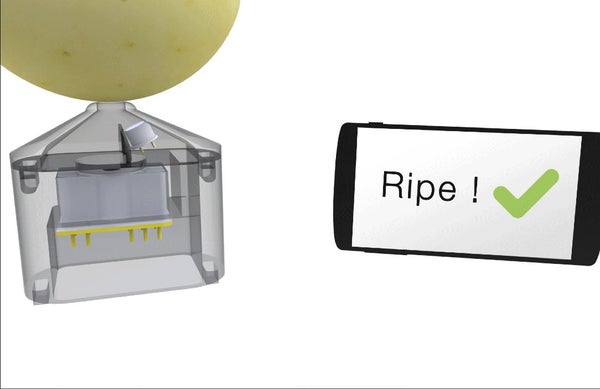
With apple-picking season in full swing throughout the U.S., people need to know when a piece of fruit is ripe for harvest. Farmers judge this by keeping track of the number of days since a tree has bloomed, or by cutting open an apple and inspecting its seeds. Amateur pickers unfamiliar with these time-tested techniques will be happy to know that researchers can now divine when an apple is ready to eat, using a small handheld device and a smartphone.
The device is a relatively cheap optical spectrometer that sends a pulse of white LED light at an apple and uses a computer chip to read the beams’ wavelengths reflected off the skin of the fruit. Spectrometers measure the interaction of light with different materials—in this case ultraviolet light waves reflected by chlorophyll in the skin. As the fruit ripens both the amount of chlorophyll and the fluorescence diminish. The new device, which costs a couple hundred dollars and weighs 48 grams, then uses Bluetooth technology to wirelessly send the spectrometer data to an app on a smartphone for storage and analysis. The researchers focused on three apple types—Golden Delicious, Empire and McIntosh—because of their different colors and color patterns.
“The idea here is that the fluorescence is very sensitive and the device can pick up changes that our eyes don’t capture,” says Anshuman Das, a postdoctoral student with Massachusetts Institute of Technology’s Media Lab, who developed the compact spectrometer with researchers from Vellore Institute of Technology and Welingkar Institute of Management Development & Research, both in India. “The riper the fruit the lower the fluorescence emission from chlorophyll.” The researchers published their study Thursday in Scientific Reports.
On supporting science journalism
If you're enjoying this article, consider supporting our award-winning journalism by subscribing. By purchasing a subscription you are helping to ensure the future of impactful stories about the discoveries and ideas shaping our world today.
Courtesy of Akshat Wahi
Food-processing companies use optical spectroscopy to inspect and grade the raw products they buy. Refineries use the technology to check the chemical composition of the crude oil transported to them via train tanks and pipelines. Spectrometers can cost upward of $1,000 and are typically connected to a computer to process the information they collect. Within the past few years, however, researchers have begun to experiment with more compact devices.
Scientists at the University of Illinois at Urbana–Champaign and LensVector, a San Jose, Calif.–based maker of solid-state autofocus lenses, in 2013 built a spectrometer into an iPhone case and used the smartphone’s camera to collect light for analysis. Their goal was to create an inexpensive, handheld sensor that could connect to the Web and detect toxins, pollutants, pathogens or other molecules for medical diagnostics or environmental field work. “We are continuing to work on the approach of utilizing the smartphone’s internal camera as a spectrometer,” says Brian Cunningham, director of the University of Illinois’s Micro and Nanotechnology Laboratory. Cunningham, who was not involved in Das’s research, says he and his colleagues are working on new study that describes how a smartphone spectrometer could be used to analyze a person’s health—that of mothers and children in particular.
Das says his goal is likewise to commercialize a handheld device that can be used for a variety of sensing applications, including medical diagnostics, geologic studies and food analysis. “Several biological compounds and structures like [organic compounds], collagen and certain types of bacteria have fluorescent properties, and their emission has shown to be useful to detect many disease conditions,” he says.
At the very least, within a few years consumers might be able to use their smartphones—alone or with a handheld spectrometer—to make sure they bring home high-quality produce.