
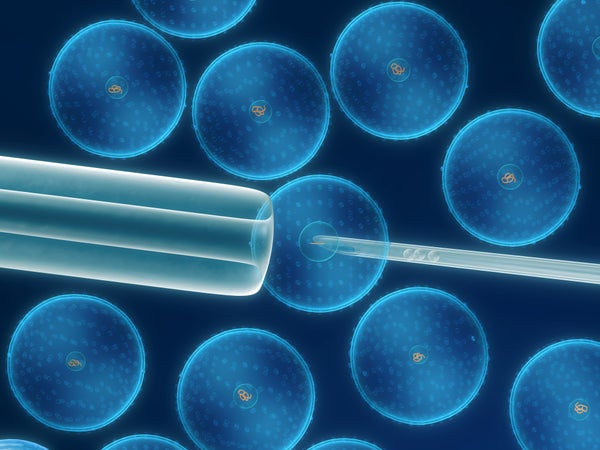
Federal health officials said Thursday they are reconsidering a moratorium on the funding of research in which human tissues are transplanted into early, nonhuman embryos—creating organisms known as chimeras.
The proposed rule changes, which the National Institutes of Health announced in a blog post, would allow the agency to pay for experiments that incorporate human tissue into early-stage animal embryos, except for those of primates like monkeys and chimps.
The NIH put a moratorium on funding early-stage embryonic chimeras in September because of ethical concerns. Some bioethicists raised concerns that animals with human brain tissue might absorb some ability to think like people. Others were concerned about what would happen if human-animal chimeras were allowed to breed.
On supporting science journalism
If you're enjoying this article, consider supporting our award-winning journalism by subscribing. By purchasing a subscription you are helping to ensure the future of impactful stories about the discoveries and ideas shaping our world today.
“I am confident that these proposed changes will enable the NIH research community to move this promising area of science forward in a responsible manner,” Carrie Wolinetz, the NIH’s associate director for science policy, wrote in the blog post.
The announcement was first reported by NPR.
Since September’s moratorium, scientists have accused the NIH of stifling science with a draconian and rash decision, arguing it was preventing a deeper understanding of how embryos develop and how cells, tissues, and organs could be used to treat disease—a burgeoning field known as regenerative medicine. Scientists argue that steps can be taken to address the ethical concerns inherent in conducting chimera research.
In the blog post, Wolinetz said the NIH was creating a steering committee that would advise NIH officials on funding decisions regarding early embryonic human-animal chimeras. Research conducted with nonhuman primate embryos would only be supported after a certain stage of embryonic development, she wrote. For now, the NIH is asking for feedback on the proposed rule changes through Sept. 4.
The blog post also said that the NIH is not going to fund research that involves the breeding of chimeras that include human egg or sperm cells. In theory, that could lead to a mostly human embryo being carried in a mouse womb, which would presumably be miscarried.
Human-mouse chimeras have been used in studies for decades, but as scientists started transplanting brain tissue in more recent years, the ethical issues were kicked up a notch. Such research could provide new insights into conditions like Alzheimer’s and schizophrenia, but some people were left uneasy with the idea that a mouse could gain human cognition.
Advocates for animal welfare have also questioned the impact of tissue transplants on the animal recipients.
In a call with reporters Thursday, Wolinetz said that with new advances in the stem cell field and gene-editing technology, “we’ve begun to creep a little bit closer to the science leading to some of those ethical concerns.”
That’s why the NIH decided “to take a deep breath and pause” in September, Wolenitz said. The moratorium did not affect any funding of ongoing projects, so it allowed NIH officials to take a survey of where the field stood at the moment and come up with its proposed policies.
Wolinetz said the steering committee would act as an “extra set of eyes” as it advises the agency that will make a decision whether to fund research projects. She said the committees will be weighing what kind of human cells are being introduced and whether the genomes in them have been edited; what kind of species of animal the researchers are using and in what stage of development it is; how researchers will control where the human tissue winds up; and how researchers will address the impact on the animal as well as its behavior, cognition, and welfare.
As for the pushback the agency got from some scientists, Wolinetz said it reflected an “understandable impatience.” Researchers in the field are eager to move ahead with their work, and the uncertainty around how long the moratorium would last caused some anxiety.
“This is a really exciting and promising area of research,” she said.
To make sure scientists have a say in the policies, Wolinetz recommended that they participate in the public comment period.
Republished with permission from STAT. This article originally appeared on August 3, 2016