
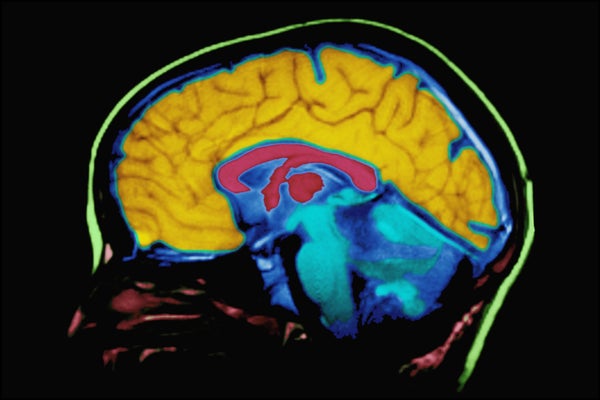
Think of a spinning globe and the patchwork of countries it depicts: such maps help us to understand where we are, and that nations differ from one another. Now, neuroscientists have charted an equivalent map of the brain’s outermost layer—the cerebral cortex—subdividing each hemisphere's mountain- and valley-like folds into 180 separate parcels.
Ninety-seven of these areas have never previously been described, despite showing clear differences in structure, function and connectivity from their neighbours. The new brain map is published today in Nature.
Each discrete area on the map contains cells with similar structure, function and connectivity. But these areas differ from each other, just as different countries have well-defined borders and unique cultures, says David Van Essen, a neuroscientist at Washington University Medical School in St Louis, Missouri, who supervised the study.
On supporting science journalism
If you're enjoying this article, consider supporting our award-winning journalism by subscribing. By purchasing a subscription you are helping to ensure the future of impactful stories about the discoveries and ideas shaping our world today.
Neuroscientists have long sought to divide the brain into smaller pieces to better appreciate how it works as a whole. One of the best-known brain maps chops the cerebral cortex into 52 areas based on the arrangement of cells in the tissue. More recently, maps have been constructed using magnetic resonance imaging (MRI) techniques—such as functional MRI, which measures the flow of blood in response to different mental tasks.
Yet until now, most such maps have been based on a single type of measurement. That can provide an incomplete or even misleading view of the brain's inner workings, says Thomas Yeo, a computational neuroscientist at the National University of Singapore. The new map is based on multiple MRI measurements, which Yeo says “greatly increases confidence that they are producing the best in vivo estimates of cortical areas”.
Divide and conquer
To construct the map, a team led by neuroscientist Mathew Glasser at Washington University Medical School used imaging data collected from 210 healthy young adults participating in the Human Connectome Project, a US government-funded initiative to map the brain’s structural and functional connections. The information included measurements of cortical thickness; brain function; connectivity between regions; topographic organization of cells in brain tissue; and levels of myelin—a fatty substance that speeds up neural signalling.
Glasser looked for areas in the cerebral cortex where he saw significant changes in two or more properties, and used these to delineate borders on the map. “If you crawl along the cortical surface, at some point you are going to get to a location where the properties start changing, and where multiple independent properties change in the same place,” he says.
The technique confirmed the existence of 83 previously reported brain areas and identified 97 new ones. Scientists tested their map by looking for these regions in the brains of 210 additional people. They found that the map was accurate, but that the size of the areas in it varied from person to person. These differences may reveal new insights into individual variability in cognitive ability and disease risk.
Limited view
“While the focus of this work was on creating a beautiful, reliable, average brain template, it really opens up the possibility to further explore the unique intersection of individual talents with intellectual and creative abilities—the things that make us uniquely human,” says Rex Jung, a neuropsychologist at the University of New Mexico in Albuquerque.
But the map is limited in some important ways. For one, it reveals little about the biochemical underpinnings of the brain—or about the activity of single neurons or small groups. “It is analogous to having a fantastic Google Earth map of your neighbourhood, down to your individual back yard,” says Jung. “Yet, you cannot really see how your neighbours are moving around, where they are going or what sort of jobs they have.”
“We’re thinking of this as version 1.0,” says Glasser. “That doesn’t mean it’s the final version, but it’s a far better map than the ones we’ve had before.”
This article is reproduced with permission and was first published on July 20, 2016.