
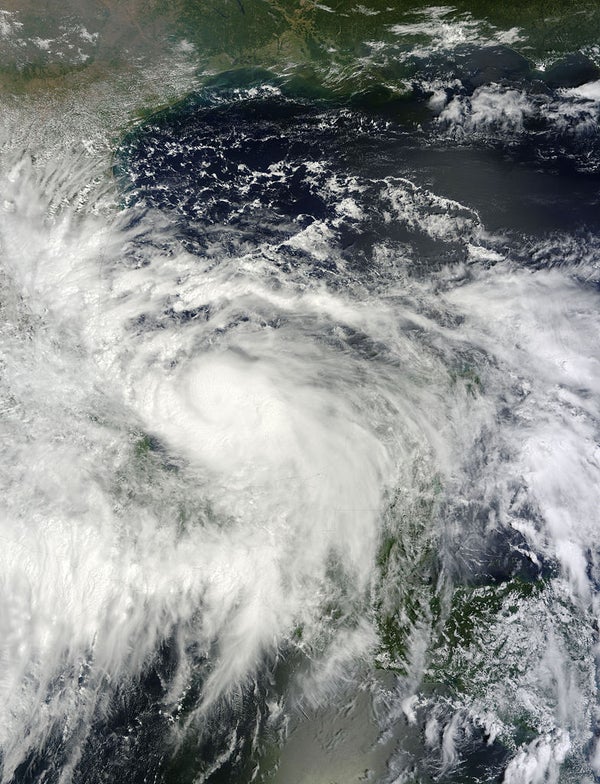

Saturday was a quiet day across the Gulf of Mexico, but not one without note, because a strange record was set: It has been 1,048 days since a hurricane developed in or entered the Gulf. That is the longest streak in the past 130 years, since formal record-keeping began in 1886.
The Atlantic hurricane season starts in June and lasts through the end of November. But the last storm in the Gulf was Hurricane Ingrid, which made landfall in northeastern Mexico in September 2013. "You have to have conditions just right for a hurricane to form, and the conditions haven't been ideal in the Gulf of Mexico in the last two years," says Robbie Berg, a hurricane specialist at the National Hurricane Center. The last long Gulf hurricane drought was from October 1, 1929, to August 13, 1932. It was broken by Hurricane 2, which came ashore in Freeport, Texas, as a category 4 storm.
Hurricanes usually form when ocean water has been warmed over the summer months to around 25 degrees Celsius or higher. As humid air and clouds accumulate, light, sweeping winds moving westward from Africa can steer the clouds across the mid-Atlantic toward the Gulf. In some cases, the mass of moisture can begin rotating as it advances. This early stage is known as a tropical depression, which can strengthen to become a tropical storm if the wind direction and speed throughout all levels of the atmosphere remain relatively constant. To be considered a category 1 hurricane or higher, the wind speed inside the rotating storm needs to be at least 119 kilometers per hour (74 miles per hour).
On supporting science journalism
If you're enjoying this article, consider supporting our award-winning journalism by subscribing. By purchasing a subscription you are helping to ensure the future of impactful stories about the discoveries and ideas shaping our world today.
Several tropical depressions and tropical storms have arisen in the Gulf of Mexico in the past couple years, but none intensified to achieve hurricane status. Winds across the upper levels of the atmosphere have been strong, which can tear clouds apart, keeping storms from strengthening, Berg says.
Weaker hurricane seasons are not unusual, especially in the Gulf of Mexico, according to hurricane forecaster Gerry Bell at the National Oceanic and Atmospheric Administration (NOAA). Hurricanes are more likely to form in the Atlantic Ocean because there's more room to develop there than in the Gulf. And wind currents often direct Atlantic storms north and west toward the U.S east coast or out into the North Atlantic instead of crossing into the Gulf. The drought can end anytime, however, because the most active part of the season—from August to October—is yet to come.
Despite the long hiatus, NOAA still anticipates a normal Atlantic season with a 70 percent likelihood of 10 to 16 named storms. “Not having hurricanes in the Gulf of Mexico doesn’t mean that people should become complacent or forget how to prepare for one,” Berg says.