
Editor’s note (4/2/2017): This week marks the 100-year anniversary of the U.S. entry into the First World War. Scientific American, founded in 1845, spent the war years covering the monumental innovations that changed the course of history, from the first tanks and aerial combat to the first widespread attacks with chemical weapons. To mark the centennial, we are republishing the article below and many others. For full access to our archival coverage of the Great War sign up for an All Access subscription today.
OCTOBER 1966
From DNA to Proteins
On supporting science journalism
If you're enjoying this article, consider supporting our award-winning journalism by subscribing. By purchasing a subscription you are helping to ensure the future of impactful stories about the discoveries and ideas shaping our world today.
“The hypothesis that the genes of the living cell contain all the information needed for the cell to reproduce itself is now more than 50 years old. Implicit in the hypothesis is the idea that the genes bear in coded form the detailed specifications for the thousands of kinds of protein molecules the cell requires for its moment-to-moment existence: for extracting energy from molecules assimilated as food and for repairing itself as well as for replication. It is only within the past 15 years, however, that insight has been gained into the chemical nature of the genetic material and how its molecular structure can embody coded instructions that can be ‘read’ by the machinery in the cell responsible for synthesizing protein molecules.—Francis H. C. Crick”
In 1962 Crick had shared a Nobel Prize for his work on DNA.
Cold War Espionage
“Testimony by two scientists intimately involved in the wartime work at Los Alamos noted that the secret ‘cross-section sketch’ introduced in the espionage trial of Julius and Ethel Rosenberg and Morton Sobell in 1951 was worthless as a description of the bomb. The two scientists are Henry Linschitz, of Brandeis University, and Philip Morrison, of the Massachusetts Institute of Technology. On motion by Sobell, who is serving a 30-year sentence in Federal prison, the secret portion of the trial record has been opened to public inspection. Linschitz declared: ‘It is not possible in any technologically useful way to condense the results of a two-billion-dollar development effort into a diagram, drawn by a high-school graduate machinist on a single sheet of paper.’”
In 2008 Sobell, at age 91, admitted turning over military information to the Soviet Union.
OCTOBER 1916
Warfare and Tanks
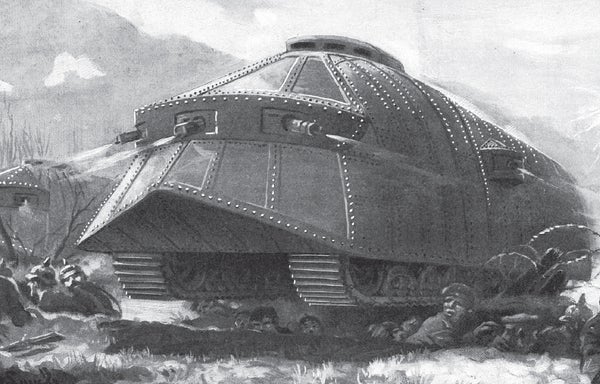
“The most novel, if not the most spectacular feature of the recent successful offensive by the French and British armies on the Somme, was the presence of several armed and armored tractors [see illustration], which, if we may judge from the press reports, proved wonderfully effective in following up the heavy gun attack. What part these machines are destined to play in the later stages of the war is a matter of pure speculation. The British speak of them as a great success; Berlin, naturally, describes them as being a complete failure—unwieldy, slow, and liable to break down.”
Archive images on aspects of modern warfare in 1916 are at www.Scientific American.com/oct2016/warfare
Power from the Sun
“It appears that although coal-fed steam boilers have been improved, sun boilers will be brought to a far better state of efficiency. This view is supported by recent experiments conducted at Meadi on the Nile River, 7 miles south of Cairo, during two years' work. The plant was composed of five 205-foot boilers in the focus of five channel-shaped mirror reflectors, totaling an area of 13,269 square feet. The maximum quantity of steam produced was equal to 63 brake horse-power per acre of land occupied by the plant. These results seem to indicate the great value of solar boiler operation, especially where sunshine is plentiful and coal scarce.”
OCTOBER 1866
Grasshopper Scourge
“The Kansas farmers in Brown County and the adjacent territory appear to have been lately subjected to a plague similar to those inflicted on Pharaoh. The obstinate grasshoppers appeared in countless numbers, covering a track twelve miles in width, and consuming almost all vegetation. The Marysville Enterprise says: ‘They alighted upon fields, gardens, fruit trees, and everything green or eatable, and, like a march of two hundred and fifty army corps, devoured every thing they touched. This whole country has been taken by them. Farmers are seriously alarmed lest the corn will be totally devoured.’”
