
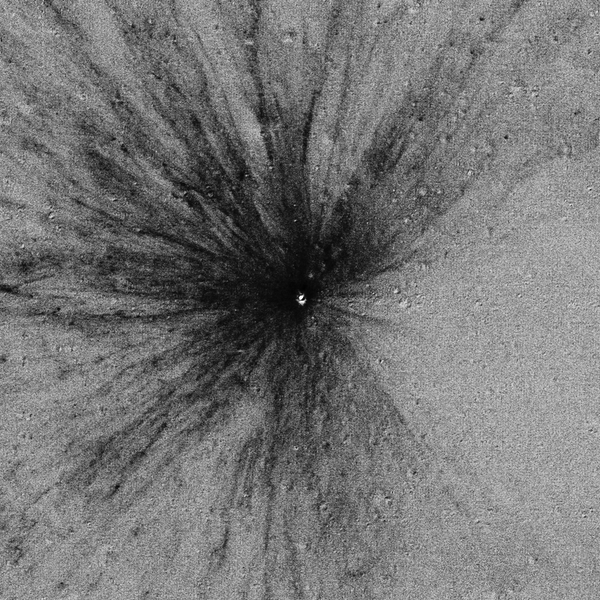
Meteorites have punched at least 222 impact craters into the Moon's surface in the past 7 years. That’s 33% more than researchers expected, and suggests that future lunar astronauts may need to hunker down against incoming space rocks.
“It's just something that's happening all the time,” says Emerson Speyerer, an engineer at Arizona State University in Tempe and author of a October 12 paper in Nature.
Planetary geologists will also need to rethink their understanding of the age of the lunar surface, which depends on counting craters and estimating how long the terrain has been pummelled by impacts.
On supporting science journalism
If you're enjoying this article, consider supporting our award-winning journalism by subscribing. By purchasing a subscription you are helping to ensure the future of impactful stories about the discoveries and ideas shaping our world today.
Although most of the craters dotting the Moon's surface formed millions of years ago, space rocks and debris continue to create fresh pockmarks. In 2011, a team led by Ingrid Daubar of NASA’s Jet Propulsion Laboratory in Pasadena, California, compared some of the first pictures taken by NASA’s Lunar Reconnaissance Orbiter (LRO), which launched in 2009, with decades-old images taken by the Apollo astronauts. The scientists spotted five fresh impact craters in the LRO images. Then, on two separate occasions in 2013, other astronomers using telescopes on Earth spotted bright flashes on the Moon; LRO later flew over those locations and photographed the freshly formed craters.
Forever young
LRO has taken about a million high-resolution images of the lunar surface, but only a fraction cover the same portion of terrain under the same lighting conditions at two different times. Speyerer’s team used a computer program to automatically analyse 14,092 of these paired images, looking for changes between the two. The 222 newfound craters are distributed randomly across the lunar surface, and range between 2 and 43 metres in diameter.
There are more fresh craters measuring at least 10 metres across than standard cratering calculations would suggest. This could mean that some young lunar surfaces may be even younger than thought, says Daubar. She calls the work “a significant advance in the field of crater chronology”, noting that it can even be used to compare cratering rates on the Moon and Mars.
Meteorites can churn up the lunar surface in several ways. Along with the fresh craters, Speyerer's team found more than 47,000 ‘splotches’, formed when material gets kicked up by the main impact and rains down—sometimes tens of kilometres away.
And that means a bigger risk for any future lunar habitats, says Stephanie Werner, a planetary geologist at the University of Oslo. The chances of a lunar base being nailed by a direct meteorite hit are relatively small, but the splattered material could pose a hazard. Werner is part of a team that has proposed a combined orbiter–lander mission to the European Space Agency, which would study impact flashes at the Moon and quantify the risk.
This article is reproduced with permission and was first published on October 12, 2016.