
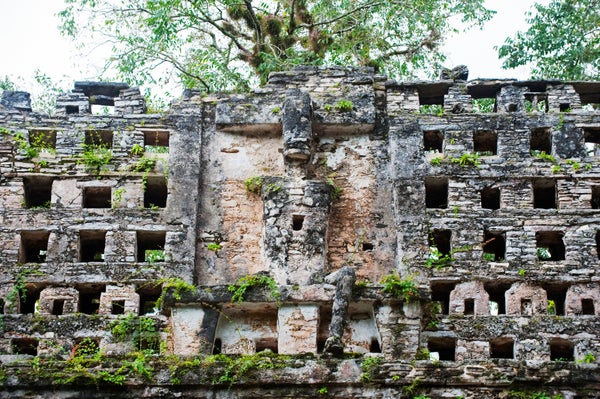
Much is known about Maya kings, lords and priests. Gaps remain, but we have long had some idea of how they lived. But what about the majority—the rest of Maya society? This question has been harder to answer. To shed some light on the subject, doctoral student Ashley Sharpe at the University of Florida examined animal bones found in three Maya cities.
The bones belong to the university’s Florida Museum of Natural History collection, of which Kitty Emery is one of the curators and co-author of the study published in a recent issue of the Journal of Anthropological Archaeology. Their conclusions reveal a world where elites did not necessarily choose to eat everything that was available, and where members of the lower classes were ready to carry food for kilometers for both economic and social purposes.
Complicated social system
On supporting science journalism
If you're enjoying this article, consider supporting our award-winning journalism by subscribing. By purchasing a subscription you are helping to ensure the future of impactful stories about the discoveries and ideas shaping our world today.
The Maya formed one of the most important pre-Columbian civilizations, and their pyramids still cast shadows over the jungles of southern Mexico and northern Central America. They developed the concept of zero and a ballgame that prohibited players from using their feet. Their mythology records their artwork on their buildings and their bloodline remains in the many indigenous descendants now living in areas including Yucatán and Guatemala.
But most Maya people did not belong to the elite, whose world is the one more clearly reflected by their civilization’s remaining art and architecture. Instead they were part of what we now describe as “middle” or “lower” classes—groups not devoted to political, military or religious leadership.
Sharpe and Emery’s study focuses on Aguateca, Piedras Negras and Yaxchilan, capitals during the late Classic period (A.D 500 to 900) and indicates that the Maya had a complex social system regulating trade, food distribution and access to animal species. Although it may seem strange at first glance, research shows it was the middle classes ate the widest range of animals. In contrast, the upper echelons’ diet was mainly focused on species that had great symbolic value for Maya, such as the powerful jaguars and crocodiles that roamed the Central American jungles. “We expected the elites to have the greatest diversity [in consumption of animal species], but it wasn’t like that. The elites ate animals that were considered delicacies, similarly to how today people of upper classes eat things like caviar, but the rest of us think that is not very appealing,” Emery said in a press release.
Geography also played a role. Whereas poor inhabitants of coastal areas had a diet that included local resources such as fish and shellfish, socially important residents of other areas were not left with only food from their environment but had access to shellfish—even in places 160 kilometers from the coast. In such inland locations mollusk shells were also used in crafts, a sign that the shells had social value, and home flooring, an indication of commercial value. The study explains that if the elites of a city had control over a resource, they presumably had some kind of control over the populations that obtained and manually transported it.
More evidence on the bones
Another discovery confirmed in the three cities is that although different classes ate the same animals, not everyone consumed the same parts. This conclusion was reached after analyzing the remains of white-tailed deer, and points to the social division of food: The best parts were for the elite. “It’s the first time we're seeing this kind of evidence about what the middle and lower classes were doing,” Sharpe says. “This study demonstrates the diversity of roles that animals played in Mayan society and economy, which were far beyond dietary preference. Elites and nonelites living in the capital and areas of influence had different access to different species, and in some cases even to different parts of certain species,” the authors wrote in the study.
Sharpe says she agrees that the study has limitations: “More work is needed to determine whether the patterns found in this study were common throughout the Maya area, and also to know why or how these patterns exist. They probably had rules or laws that kept these practices, but we do not know the details.”