
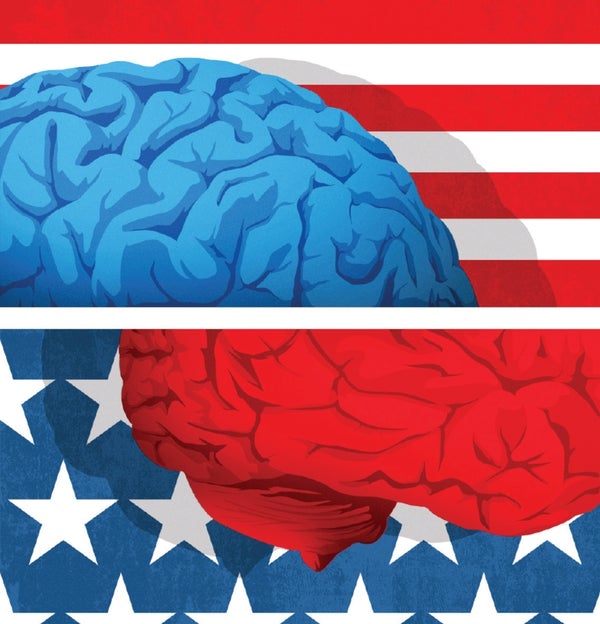
When you debate a friend on the opposite end of the political spectrum, do you sometimes feel like you are talking to someone from a different planet? That might not be far from the truth: a 2015 study in Personality and Social Psychology Bulletin suggests liberals and conservatives think as though they come if not from different planets, at least from radically different cultures.
Previous research has shown that people from cultures that are Western, educated, industrialized, rich and democratic (“WEIRD,” in psychological parlance) tend to think analytically, using logical rules, whereas those that are non-WEIRD process information more intuitively. They even perform differently on problem-solving tasks: Americans, who are more analytical, remember individual components of a complex visual scene better than East Asians, who are more holistic. Only about 15 percent of the world's population is from a WEIRD culture, yet most psychological studies use such participants.
Some researchers think culture actually shapes thought: cultures that emphasize individuality foster analytical thinking, whereas those that emphasize connectedness promote holistic thinking.
On supporting science journalism
If you're enjoying this article, consider supporting our award-winning journalism by subscribing. By purchasing a subscription you are helping to ensure the future of impactful stories about the discoveries and ideas shaping our world today.
The current study applied this framework to the realm of politics. Scientists measured 218 participants' political identification on a seven-point scale, from “very liberal” to “very conservative.” The subjects then completed tests such as the triad task, in which they saw pictures of three items—say, a panda, a banana and a monkey—and indicated which two they thought were more closely related.
Liberals acted more like Westerners, pairing items that belonged to the same abstract category (for instance, two animals), whereas conservatives tended to pair items that were functionally related (monkey and banana), as non-Westerners do. One other classic test of holistic thinking also suggested that liberals tended to use a more typically WEIRD cognitive style.
The finding that conservatives think more like those from collectivistic cultures might sound counterintuitive. Aren't liberals, who favor safety-net programs for the needy, the collectivist ones? Thomas Talhelm, now a professor of behavior science at the University of Chicago and lead author of the study, explains that true collectivism “doesn't mean general sharing with other people. It's about social ties and responsibilities to those within your group.” Antipoverty programs usually serve to help individuals get a leg up rather than strengthening groups—thus aligning with WEIRD cultures' focus on individuality.
Teasing apart the origins of these effects is not easy. Michael Varnum, a cultural psychologist at Arizona State University who was not involved in the study, believes “these group differences have their roots in people's environments.” Liberals tend to live in cities, where research suggests people think in individualistic ways, he says, whereas conservatives are often found in more rural areas, where people are more collectivist. The surrounding culture influences both cognitive style and political beliefs.
The researchers found evidence that cognitive style might directly influence political beliefs, however. In a follow-up study, participants completed the triad task with a tweak: some were told to pair items by category, and some were told to pair by relationship. Next they were asked to read an article about two contrasting welfare programs—a generous, liberal one and a stricter, conservative one—and “vote” for a plan. Those in the categorical group chose the liberal plan significantly more often than those in the relational group, suggesting that changing thought style can alter political views.
Talhelm cautions that the question is still open as to how much the thinking style of a culture shapes political beliefs in the real world. “Our political attitudes are influenced by so many things,” he explains. “This is one factor among many.”
Still, the findings have important implications. Talhelm suggests a politician making a speech to promote a liberal policy might want to “slow down and get people in an analytical mind-set,” limiting emotional appeals and sticking to the facts.
Twitter Language Reveals Political Beliefs
Democrats talk about themselves a lot and swear like sailors; Republicans say negative things and like bringing up religion. At least according to Twitter. Scientists at Queen Mary University of London analyzed the tweets of more than 10,000 users, sorting them by political party based on which American politicians' Twitter feeds they followed. They found that the frequency of certain words was highly correlated with a user's political orientation. Here are some of the more revealing findings:
