
The 2016 Nobel Prize in Medicine or Physiology was awarded to Yoshinori Ohsumi of the Tokyo Institute of Technology for basic research describing a fundamental housekeeping function of the cell—a process called autophagy. From the Greek for "self-eating," autophagy is the straightforward mechanism by which a cell digests certain large internal structures and semipermanent proteins in a continual cleanup process. The process may have evolved as a response to starvation, in which cells cannibalized some of their own parts in order to continue living. But over the eons it has become an essential tool used by cells to maintain their own health, resist infection and possibly even fight cancer.
Autophagy is particularly important in cells such as neurons, which tend to be long-lived and thus need continual renewal and refurbishment. The process takes place in the cytoplasm, the jelly-like fluid that fills the cell outside the nucleus. As described in a 2008 article in Scientific American, "the workings of the cytoplasm are so complex...that it is constantly becoming gummed up with the detritus of its ongoing operations. Autophagy is, in part, a cleanup process; the trash hauling that enables a cell whose cytoplasm is clotted with old bits of protein and other unwanted sludge to be cleaned out." Problems with autophagy may contribute to neuronal damage in Alzheimer's, Parkinson's and other neurodegenerative diseases.
Understanding autophagy has taken decades. Research in the 1950s by Belgian scientist Christian de Duve had revealed a previously unknown structure within the cell that de Duve called a lysosome. He and others determined that the organelle contained many enzymes that would, under the right circumstances, tear apart proteins and even other organelles, allowing their constituent parts to be reused or ejected by the cells. De Duve was one of three people to win the Nobel for this and other work in 1974 (pdf).
On supporting science journalism
If you're enjoying this article, consider supporting our award-winning journalism by subscribing. By purchasing a subscription you are helping to ensure the future of impactful stories about the discoveries and ideas shaping our world today.

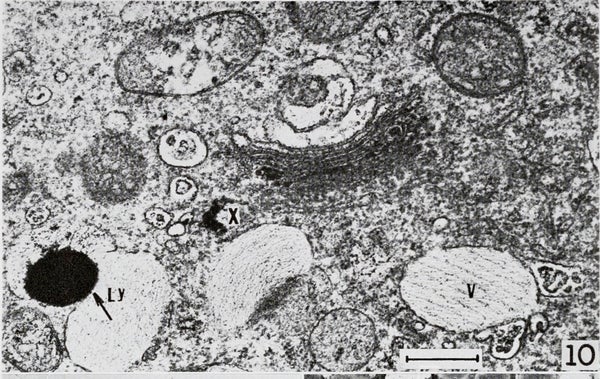
Credit: Wikimedia (CC BY 4.0)

And there things stood until the 1990s when Ohsumi decided to study the problem in yeast, which are often used in the lab to model the basic processes at work in the cells of higher organisms, including humans. For historical reasons, lysosomes in yeast are called vacuoles.
Many investigators at the time seemed to think that autophagy was important only in special circumstances, such as starvation. Vacuoles form in yeast when nutrients are scarce, which starts a process by which yeast develop spores that can spread presumably to more fertile territory. But Ohsumi viewed this lack of research focus as unique opportunity to have a research field almost entirely to himself. "I chose the transport of materials to the yeast vacuoles as my research project, because no one else was studying it," Ohsumi said in an interview after winning the Inamori Foundation's Kyoto Prize in 2012 (he also won the Janssen Award for Biomedical Research earlier this year).
Today, scientists recognize that autophagy is fundamental to a cell's continued good health and have even specialized in describing particular types of autophagy—such as the digestion and degradation of worn-out mitochondria (the cell's powerhouse ) and the endoplasmic reticulum, which assembles, folds and delivers proteins to the rest of the cell.