
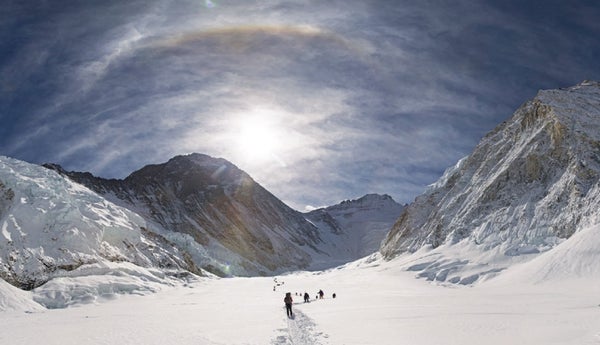

COURTESY OF ALAN L. BAUER, WWW.ALANBAUER.COM(Fagin)
Mount Everest presents endless challenges to the adventurer who dares to seek its summit: treacherous overpasses, tumbling house-sized blocks of ice and hypoxic conditions, to name a few. Weather, too, poses an acute danger on the world's highest peak. In 1996, for example, a now infamous blizzard overtook the mountain, costing eight climbers their lives. Although heart attacks, falls and avalanches cannot be anticipated, weather—at least to some extent—can. Michael Fagin, a Seattle-based meteorologist, is the go-to man for prudent climbers. Every spring major expeditions, as well as intrepid individuals, hire him to provide daily forecasts for Everest and other Himalayan peaks. Edited excerpts follow.
What weather peculiarities affect Mount Everest?
It's common to have winds at 100 mph, but in May—the most popular time to climb, just before the monsoon starts—there are usually several days with winds at reasonable levels (under 20 mph). Another abnormal atmospheric condition that you have to be tuned into is cyclones that form in the Bay of Bengal. Although Everest is about 1,500 miles to the north and not at sea level, these storms can greatly impact the mountain, bringing heavy precipitation.
On supporting science journalism
If you're enjoying this article, consider supporting our award-winning journalism by subscribing. By purchasing a subscription you are helping to ensure the future of impactful stories about the discoveries and ideas shaping our world today.
How is forecasting weather on Everest different than doing so for, say, Seattle?
The biggest difference is a lack of real-time weather observation. After I make a forecast, I cannot verify how accurate it was, because there are no weather stations on Everest. So I depend on climbers to send observations via e-mail. And while weather models in a place like Seattle provide excellent detail on a local level, for Everest the models are not on a regional scale but rather a global one—for the entire continent of Asia or the Himalayan range.
What's a typical day of work like for you during climbing season?
At 5 A.M. I look over feedback from climbers on the prior day's forecast to see which of the at least six models I use had the best handle on actual conditions—for example, the model issued by the Navy Operational Global Atmospheric Prediction System or the European Center for Medium-Range Weather Forecasts. I also look at dispatches from nonclients posted on Twitter, Facebook, Instagram and blogs. If one of the models has provided better accuracy over recent days, I'll assign a higher-weighted average for it. I'm finished by 9 A.M., but climbers in Nepal are more than half a day ahead and want updates first thing in the morning, so I take another look at 7 P.M. my time and make adjustments if needed.
How do you convey uncertainty?
I always give a “confidence rating” for my forecasts, which is critical because sometimes I'm highly confident but other times not.
Have mountaineers ever gotten angry at you because of a forecast?
One year summit winds on a Tuesday were 100 mph, and I told the expedition leader that the winds would still be strong Wednesday and Thursday. He took the entire group back down to a lower camp. Someone in the group became very angry, however, when the winds on Thursday proved not very strong, but at that point his summit bid was nixed.