
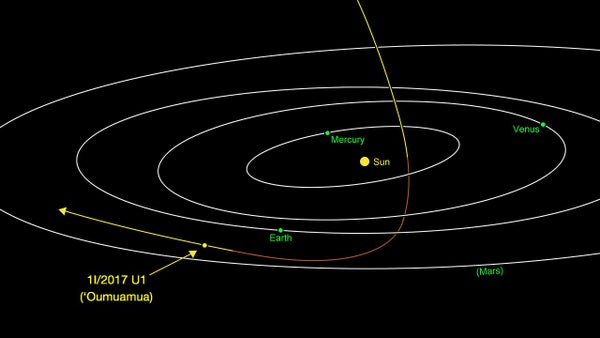
We now know what to call the mysterious object from interstellar space that zoomed past Earth last month.
The interloper—the first known interstellar body observed within our own solar system—has been named 'Oumuamua, which means "a messenger from afar arriving first" in Hawaiian, representatives of the International Astronomical Union (IAU) announced yesterday (Nov. 14).
The IAU also approved an official scientific designation for 'Oumuamua: 1I/2017 U1. This is a first-of-its-kind moniker; the "I" stands for "interstellar." Previously, small objects like 'Oumuamua have received standard comet or asteroid designations, which sport a "C" or "A," respectively, in place of the "I." [Solar System Explained from the Inside Out (Infographic)]
On supporting science journalism
If you're enjoying this article, consider supporting our award-winning journalism by subscribing. By purchasing a subscription you are helping to ensure the future of impactful stories about the discoveries and ideas shaping our world today.
'Oumuamua was first spotted on Oct. 19, by astronomers using the Pan-STARRS1 telescope in Hawaii. The smallish object was first classified as a comet but then regarded as an asteroid, after further observations revealed no evidence of a coma (the fuzzy cloud of gas and dust that surrounds a comet's core).
Analysis of 'Oumuamua's trajectory soon revealed that it was on a hyperbolic path—that is, one that will take it out of the solar system. And the object doesn't seem to have had any gravitational encounters with planets that could have nudged it onto such a path, which strongly suggests that 'Oumuamua came from interstellar space, researchers have said.
Astronomers have determined that 'Oumuamua made its closest pass by the sun on Sept. 9 and then zoomed within 15 million miles (24 million kilometers) of Earth on Oct. 14—about 60 times the distance from our planet to the moon. The object is now barreling toward the outer solar system at about 98,400 mph (158,360 km/h) relative to the sun, researchers have said.
Though 'Oumuamua's composition is unknown, the object is probably more ice than rock, Matthew Holman, director of the Minor Planet Center (MPC) in Cambridge, Massachusetts, told Space.com last month. That's because bodies that form on the outskirts of solar systems—and are therefore most likely to get booted into interstellar space—tend to be icy, Holman said.
The Pan-STARRS team proposed 'Oumuamua's common name, and the suggestion was approved by the MPC, the organization responsible for gathering data about asteroids and comets in our solar system.
The MPC operates under the auspices of the IAU, which is the arbiter of official astronomical names. The MPC proposed creating a new formal designation scheme for interstellar objects — the one with the "I" instead of the "C" or "A" for comet or asteroid — and the IAU executive committee quickly agreed, IAU representatives said.
"Considering the growing interest in the observation and orbit determination of asteroids . . . it is expected that the discovery of 1I/2017 U1 ('Oumuamua) will soon be joined by discoveries of more of such interlopers entering the inner solar system from interstellar space," IAU representatives wrote in a statement yesterday. "The scheme for their designation is ready, while the procedure for assigning them a name, similar to the one in use for minor planets, will soon be decided."
EDITOR'S RECOMMENDATIONS
Copyright 2017 SPACE.com, a Purch company. All rights reserved. This material may not be published, broadcast, rewritten or redistributed.