New Issue: Science’s Impossible Questions. Read Now

Modern Humans Used Ivory and Bone to Create Tools 30,000 Years Ago [Slide Show]

An analysis of tools found in the Russian archaeological site of Sungir shows how Homo sapiens developed techniques to mold hard materials

Arrowheads for hunting; ivory was the preferred material for these weapons.

Taisiya Soldatova

Join Our Community of Science Lovers!

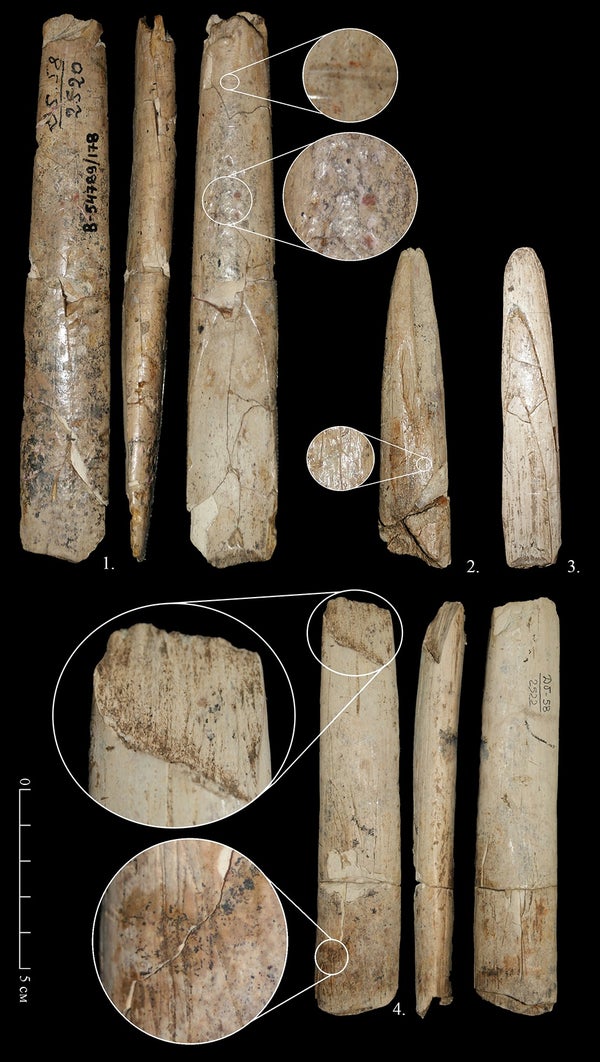
A set of pieces found in the archaeological site of Sungir, located 200 kilometers east of Moscow, offers a rich trove of clues on how Homo sapiens managed to dominate hard materials and transform them into useful tools, about 30,000 years ago.

Archaeologists from Lomonosov Moscow State University analyzed 171 objects of bone and ivory. Their findings showed that during the upper Paleolithic period modern man had already developed several complex techniques for processing hard materials, including the transverse fracture, scraping and cutting.

Taisiya Soldatova, an anthropologist at Moscow State and lead author of the research, told Scientific American that the objects not only help us to better understand the daily life of early modern humans but also offer insights on cultural ties between that area of Russia and what is now Europe. “In some areas of France, for example, techniques similar to those found in Sungir for toolmaking were used. Comparing these objects—the kind of instruments, materials and how they were created—helps us know the place Sungir occupied as a community in the region,” Soldatova says.


On supporting science journalism

If you're enjoying this article, consider supporting our award-winning journalism by subscribing. By purchasing a subscription you are helping to ensure the future of impactful stories about the discoveries and ideas shaping our world today.


The work was published by the Erlangen, Germany–based Hugo Obermaier Society for Quaternary Research and Archaeology of the Stone Age.

Subscribe to Support Independent Journalism

Great science journalism requires human expertise, time, effort and creativity. And it costs money. That’s why I and the journalists here at Scientific American hope you’ll join our community.

When you subscribe, you are supporting staff and freelance journalists who are passionate about telling science stories that are true, important and compelling. Our editors and reporters are often experts in their fields, which means they understand the nuances of big discoveries and can untangle the breakthroughs from the hype. With a subscription, you are also supporting rigorous fact-checking to ensure the words we publish are precise and accurate. And you’re supporting original illustrations, graphics and photos that bring you closer to an advanced laboratory, an ice sheet in Antarctica or a space mission in orbit. You’re helping us craft other types of high-quality journalism as well: Our newsletters are carefully written, edited and curated by staffers you have or will come to know and love. Our Science Quickly podcast is based on original reporting, collaboration with editors and scientists and exacting production.

Subscriptions keep this engine running so we can continue to deliver thoughtful, rigorous and independent science journalism to you. In an era of viral misinformation, this work is crucial. If you value what we do, I hope you’ll consider joining us as a subscriber

Thank you,

Jeanna Bryner, Editor in Chief, Scientific American

Subscribe