
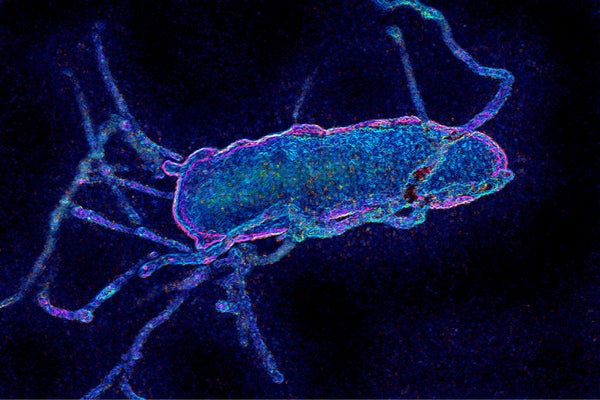
Synthetic biologists report the most far-reaching rewiring yet of a bacterial genome. The feat, described today in Science, involved repurposing 3.8% of the base pairs of the bacterium Escherichia coli.
The scientists replaced 7 of its 64 genetic codons—sequences that code for amino acids—with others that produce the same components. They were able to reduce the number of codons by synthesizing the DNA in 55 fragments, each of which was 50,000 base pairs long. They have yet to reassemble those pieces into a functioning E. coli.
Despite that, the team, led by researchers at Harvard Medical School in Boston, Massachusetts, say that it is a major step in the push to engineer organisms with new properties, such as resistance to infection by viruses. The synthetic biologists, including George Church at Harvard, reported their results on 18 August in Science. They say the work also serves as a prototype for the Human Genome Project—Write, in which scientists aim to synthesize a human genome.
On supporting science journalism
If you're enjoying this article, consider supporting our award-winning journalism by subscribing. By purchasing a subscription you are helping to ensure the future of impactful stories about the discoveries and ideas shaping our world today.
Big changes
“This is a demonstration that that kind of radical reengineering is feasible,” Church says.
“Going down from 64 to 57 codons is a dramatic departure from what exists in nature,” says Farren Isaacs, a synthetic biologist at Yale University in New Haven, Connecticut, who worked with Church on previous recoding studies but was not involved in this project. “It‘s an important step forward for demonstrating the malleability of the genetic code and how entirely new types of biological functions and properties can be extracted from organisms through genomes that have been recoded.”
Church’s lab and others have previously shown that it is possible to recode single amino acids in E. coli so that the bacterium can incorporate amino acids not found in nature. Such reprogrammed organisms are highly resistant to viral infection, because they no longer contain the genetic machinery common to all natural organisms that viruses exploit to survive. They can also be made entirely dependent on synthetic amino acids in their diets, to allay the fear that recoded bacteria could escape from a lab and wreak havoc in the wild.
We have the technology
The recoding used in the latest study is a painstaking process, and it probably would not have been possible just a few years ago. The speed of engineering and synthesizing DNA has increased massively over the past decade, enabling much more ambitious genetic-engineering projects.
“This project is at an unprecedented scale; it’s the largest completely synthesized genome that has ever been produced, and by far the most functional changes” that have been introduced into a genome, says Marc Lajoie, a synthetic biologist who worked on the project in Church's lab and is now at the University of Washington in Seattle.
Scientists led by genomic entrepreneur Craig Venter of the J. Craig Venter Institute in La Jolla, California, announced in March that they had created a synthetic genome based on a bacterial genome with all unnecessary genes removed. But that organism’s genome was an order of magnitude smaller than E. coli’s.
Church and his team are now attempting to stitch the DNA segments of their recoded E. coli into one continuous genome. They will then test whether that reconstituted organism is capable of life. Church says it is unclear how long this will take; members of his lab estimate that it could be anywhere from four months to four years.
“It will be a big effort, but it looks like it's going to happen,” says Isaacs.
This article is reproduced with permission and was first published on August 18, 2016.
