
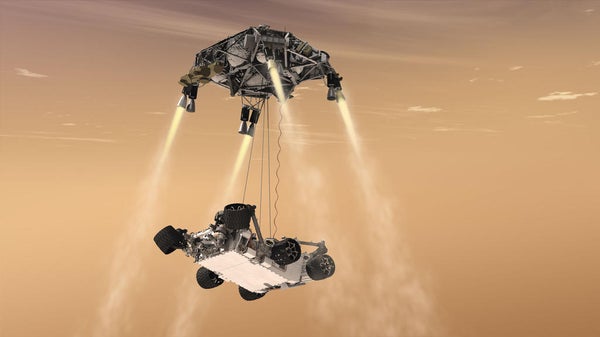
If all goes according to plan, the touchdown of NASA's next Mars rover will be the most documented planetary landing in history.
The space agency's 2020 Mars rover will carry special cameras and microphones to capture stunning views and sounds of its dramatic descent to the Red Planet's surface in 2021. (The robot will launch in 2020, hence the name.)
These cameras "are going to produce some of the most exciting imagery I think a planetary mission has ever provided," said Mars 2020 rover deputy project manager Matthew Wallace, of NASA's Jet Propulsion Laboratory in Pasadena, California. [NASA's Mars Rover 2020 Mission in Pictures]
On supporting science journalism
If you're enjoying this article, consider supporting our award-winning journalism by subscribing. By purchasing a subscription you are helping to ensure the future of impactful stories about the discoveries and ideas shaping our world today.
But the hardware will provide more than just gee-whiz appeal.
"The entry, descent and landing [EDL] cameras are, in my mind, first and foremost engineering tools," Wallace told Space.com.
An unprecedented view
The Mars 2020 rover will touch down in much the same way that NASA's Curiosity rover did in August 2012. That is, the six-wheeled robot will rely on a big parachute to slow itself down in the Mars atmosphere initially, then be lowered to the Red Planet's surface by a rocket-powered "sky crane."
The EDL cameras will give researchers and engineers an unprecedented look at how all of this gear works in the Martian setting, Wallace said.
"We have never seen a parachute open up on Mars before," he said. "The parachute has always been a focus of our risk conversations. We want to understand the physics of parachute inflation as much as we possibly can."
The various microphone-carrying cameras should also record the 2020 rover's heat shield dropping away and the operations of the sky crane, Wallace added.
"These are all going to be hugely beneficial to understand the sky crane better," Wallace said.
A number of future Mars landing architectures make use of the sky crane system, which has significant growth potential, he said.
Big wheels turning
The microphones will keep rolling after touchdown, too, capturing a variety of sounds.
"We'll hear wheels turning, the drill drilling, probably hear the rover's mast moving," Wallace said. "Wind interactions, at least fairly high-speed winds—I would think we'd hear those too."
The team also recently decided to add a microphone to the rover's laser-firing SuperCam.
Mounted on the "head" of the rover's long-necked mast, SuperCam can provide imaging, chemical-composition analysis and mineralogy data. The instrument will also be able to detect the presence of organic compounds in rocks and Mars dirt (or regolith) from a distance.
"So when they actually fire the laser and collect spectral data, they'll also be able to collect sound data at the same time," Wallace said.
The microphones are primarily a public-outreach tool, Wallace said. But sound can also be an important engineering diagnostic, sometimes providing a first indication that a pump or other hardware isn't quite up to snuff, he added.
"You can hear very well things that originate within 10 to 20 feet [3 to 6 meters] of the microphone," Wallace said. "We're going to hear a lot of great stuff."
Destination Mars: NASA’s 2020 Mars Rover Science Plan | Video
How Mars Rover Curiosity's Nail-Biting Landing Works (Pictures)
Copyright 2016 SPACE.com, a Purch company. All rights reserved. This material may not be published, broadcast, rewritten or redistributed.