
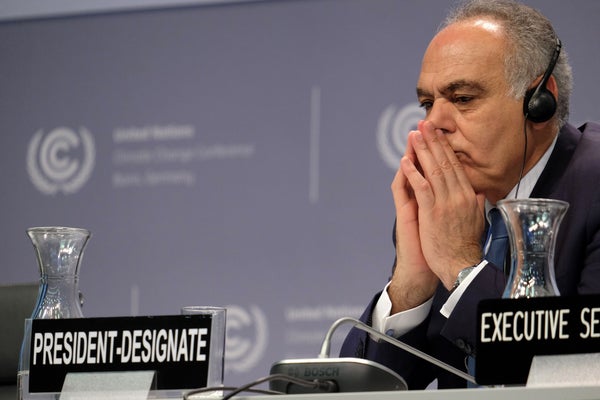
Climate negotiators from around the world met yesterday for the first time since brokering the Paris climate deal to start filling in some of the gaps left in that landmark agreement.
The midyear U.N. meeting in Bonn, Germany, was much lower-profile than the confab on the outskirts of the French capital in December. And the agenda was more mundane.
“It’s going to be a very weird session,” outgoing U.N. Framework Convention on Climate Change chief Christiana Figueres told ClimateWire last week on the margins of another international meeting in the Rhine River city. “It’s going to be a lot of housekeeping and planning ... not much of interest to the outside world.”
On supporting science journalism
If you're enjoying this article, consider supporting our award-winning journalism by subscribing. By purchasing a subscription you are helping to ensure the future of impactful stories about the discoveries and ideas shaping our world today.
To the international bureaucrats gathered in Bonn, this is an opportunity to solidify the gains made last year and to begin turning them into the actions that could keep post-industrial warming to below 2 degrees Celsius.
More than 175 countries have endorsed the Paris deal since it opened for signature last month in New York. But its goals rest on more than 60 unmet decisions on issues like emissions reporting, how national and collective progress will be assessed, and other “homework” items Bonn will begin to turn in.
The two-week meeting will deliver an agenda for the ad-hoc working group tasked with implementing the Paris Agreement. Sarah Baashan of Saudi Arabia and Jo Tyndall of New Zealand have been nominated to co-chair the working group. New Zealand proposed the basic architecture for what would become the Paris deal—which has binding and nonbinding elements to achieve each nation’s differing climate commitments. Saudi Arabia has yet to sign the agreement.
In a joint paper published on the UNFCCC website late last week, the current French presidency and the incoming Moroccan presidency of the Conference of the Parties suggested a slate of work items for the Bonn meeting, the end-of-year meeting in Marrakech and beyond.
Besides working to facilitate early entry into force for the Paris deal—which takes effect when 55 countries totaling at least 55 percent of the world’s greenhouse gas emissions have joined—the presidents called for parties to “respect the balance that was found and to continue working together so as to strengthen action, support and ambition.”
The presidencies also noted that it is likely the deal will enter into force earlier than was expected last year during negotiations. If it comes online before the work program has been completed, they wrote, parties will need to take “appropriate steps” to ensure that countries that have not yet joined the deal can participate in remaining decisions.
“We consider that no Party should be disadvantaged or excluded from the collective development of the rulebook of the Paris Agreement simply because it is still in the process of joining the agreement,” they wrote.
A slump, wrangling and lost momentum
The European Union was among the strongest proponents of the Paris deal, but it has said it faces procedural hurdles that will require more time for it to join.
Alden Meyer, director of strategy and policy for the Union of Concerned Scientists, said the goal of the presidents is for a work process in which no issue would be “left behind” as Paris moves into its implementation phase.
“This will not be an unbalanced package,” he said at a briefing with reporters in Bonn yesterday.
Achieving this will mean a greater emphasis on action before the deal’s commitment period begins in 2020. Bonn will also play host to meetings with technical experts on issues like energy, transport, cities and—for the first time—adaptation. The meetings are aimed at identifying barriers to action and removing them.
In an op-ed on the website Climate Home, Mohamed Adow, the senior climate adviser for Christian Aid, said there is some danger that the goodwill of Paris could give way to “a slump, wrangling about process and losing momentum rather than building on what we’ve just achieved.”
“With the Paris deal last year being the biggest and most successful breakthrough in 21 years of climate negotiations, there is potential for a very big hangover,” he warned.
One solution, he said, is to begin preparing early to resubmit tougher climate commitments following the assessment of ambition planned for 2018. He also advocated action in other fora and a renewed focus on keeping warming to the aspirational limit of 1.5 degrees Celsius.
Small island nations, meanwhile, called for both mitigation and a renewed focus on climate aid—and in particular a clearer view of where the developed world’s promise to mobilize $100 billion a year by 2020 will come from. They are particularly interested in how much will go to adaptation.
“We simply cannot solve climate change without adequate support,” said Thoriq Ibrahim, minister of environment and energy for the Maldives and chairman of the Alliance of Small Island States (AOSIS), in a statement yesterday. “We look forward to the action required to fulfill the promises made.”
Jake Schmidt, director of international programs at the Natural Resources Defense Council, said the first meeting after a summit usually includes an “agenda fight,” in which parties vie to secure priority for their issues as negotiations continue. But he said this year might be different because Paris is in the rearview mirror.
“This is not the rush to the final decision meeting,” he said. Rather than focusing on text, the next two weeks will start to flesh out ideas for this next phase of the decisionmaking process.
Reporter Umair Irfan contributed.
Reprinted from Climatewire with permission from Environment & Energy Publishing, LLC. www.eenews.net, 202-628-6500