
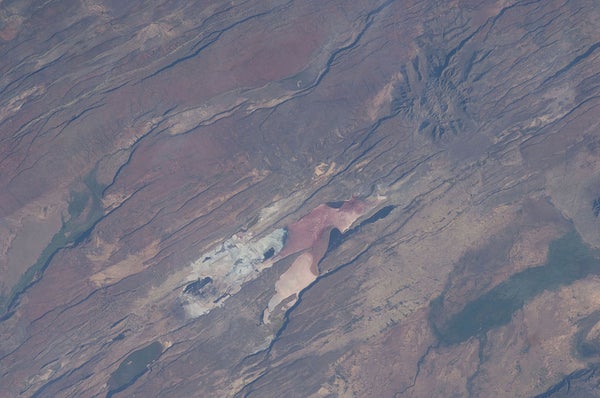
Using a new technique, scientists have discovered reserves of helium in Tanzania said to be equivalent to seven times the amount of the noble gas consumed worldwide each year. The new source could alleviate recurrent shortages of helium that have plagued users of scientific instruments and medical imaging equipment.
Working with the start-up firm Helium One, scientists at Oxford and Durham universities uncovered the reserves in Tanzania’s East African Rift Valley. The researchers theorize that intense heat from volcanic activity in the Rift Valley releases helium in ancient crustal rock. The gas then accumulated in underground reservoirs.
The scientist say they have combined methods used in oil exploration with seismic images of gas-trapping structures and calculations from independent experts to estimate helium reserves of 1.5 billion m3 in just one part of the Rift Valley.
On supporting science journalism
If you're enjoying this article, consider supporting our award-winning journalism by subscribing. By purchasing a subscription you are helping to ensure the future of impactful stories about the discoveries and ideas shaping our world today.
The scientists presented the findings on June 28 at the Goldschmidt Conference, a gathering of geochemistry experts in Yokohama, Japan.
Today, helium is recovered as a by-product of natural gas extraction. But with prices of helium now about four times higher than they were a decade ago, prospectors are looking for new sources. The Tanzania helium reserve would be the first to be discovered and developed intentionally.
“We would be able to effectively ratchet production up or down depending on what the world required,” Helium One CEO Tom Abraham-Jones tells C&EN. The year-old start-up is now trying to raise $40 million from industrial gas companies and other investors to complete exploration at sites licensed from the Tanzania government. Abraham-Jones estimates the cost of building a helium purification plant at about $100 million.
If the Tanzania reserve turns out to be as large as it now appears, “it could be an important discovery,” says Phil Kornbluth, a consultant to Helium One who previously ran the helium operations of Matheson. But, he cautions, “it’s still early days” for the start-up firm.
This article is reproduced with permission from Chemical & Engineering News (© American Chemical Society). The article was first published on June 28, 2016.

