
Editor's note: The following essay is reprinted with permission from The Conversation, an online publication covering the latest research.

Tens of millions of people have flocked to theatres this summer to see Jurassic World, an action flick “starring” a team of trained Velociraptors that hunt genetically modified dinosaurs on command of their human master.
On supporting science journalism
If you're enjoying this article, consider supporting our award-winning journalism by subscribing. By purchasing a subscription you are helping to ensure the future of impactful stories about the discoveries and ideas shaping our world today.
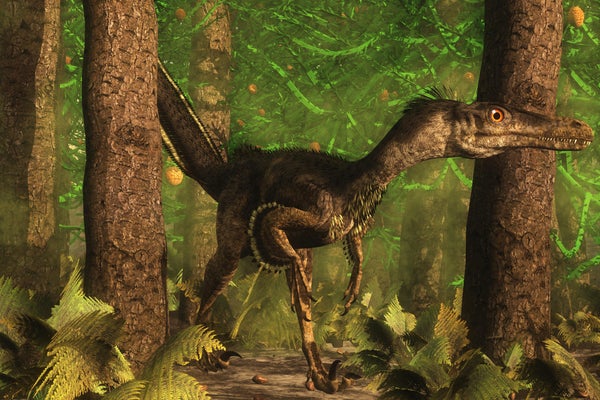
It’s a preposterous storyline of course, but very entertaining. I study dinosaurs for a living and it didn’t bother me to see Velociraptors being used as hunting dogs for the sake of good cinema. What I didn’t like, however, was that the Velociraptors were depicted as big, drab-coloured, scaly brutes.
That’s because the real Velociraptor was a lapdog-sized predator covered in feathers. Palaeontologists have known this for a while. If you look at the arm bones of Velociraptoryou can see a row of bumps, identical in size and shape to the quill knobs of living birds: the anchor points for big wing feathers. But because Velociraptor hasn’t been found in the perfect geological settings that fossilise soft tissues, we don’t know exactly what its feathers would have looked like.
But we have a better idea now, thanks to the discovery of a spectacular new dinosaur from northeastern China that I studied with my colleague, Junchang Lü of the Chinese Academy of Geological Sciences.
Our new dinosaur, Zhenyuanlong, is one of the closest cousins of Velociraptor. Its gorgeous chocolate-coloured skeleton was found by a farmer in 125-million-year-old rocks that were laid down in a quiet lake buried by volcanic ash. It’s just the right environment for preserving the soft bits that usually decay before a fossil is formed.

Fluffy, feathered poodle from hell. Credit: Junchang Lü and Stephen L. Brusatte Wikimedia(CC BY 4.0)

Zhenyuanlong is covered in feathers. Simple hairy filaments coat much of the body, larger veined feathers stick out from the tail, and big quill-pen-feathers line the arms, layered over each other to form a wing. This is a dinosaur that looks just like a bird. If you could see it alive you would probably make no distinction between it and, say, a turkey or a vulture.
Look at Zhenyuanlong and you see what the real Velociraptor would have been like. Far from being a scaly-skinned reptilian monster, Velociraptor would have been a fluffy, feathered poodle from hell.
Dinosaurs such as Zhenyuanlong and Velociraptor are some of my favourite fossils to study. They fascinate me because they capture evolution in action. These small, fast-running, brainy predators are some of the closest relatives of birds. They are chapters in one of the greatest stories in the history of life: the evolutionary transition between fearsome carnivorous dinosaurs and their 10,000 feathered descendants that live on today, all over the world.
And this is why the discovery of Zhenyuanlong is really important. It gives us new insight into this incredible moment in evolution. Zhenyuanlong is fairly large for a close relative of birds, two metres long from snout to tail. It also has much shorter arms than Velociraptor or birds. A big, short-armed animal probably wasn’t flying, so what was it doing with its wings? We don’t know for sure.
This opens up a whole new mystery for us to solve: why did wings evolve? Did they evolve for flight, or did they first develop for something else, and were later co-opted to be used as an airfoil? We don’t know the answer yet, but since new fossils of bird-like dinosaurs are being found at an incredible rate, maybe we’ll have it solved by the time the next Jurassic Park comes out.
Stephen Brusatte, at the University of Edinburgh, receives funding from National Science Foundation, European Commission.
This article was originally published on The Conversation. Read the original article.