
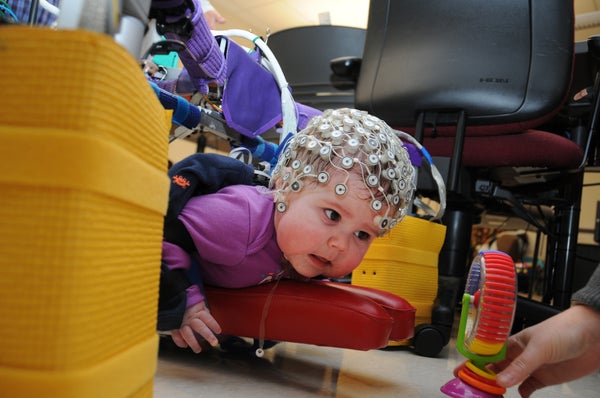
For infants with cerebral palsy, crawling can be a challenge. The children, who suffer from brain damage that impairs muscle control, frequently give up trying to master moving across the floor. In turn, the brain stops building and reinforcing connections involved in developing motor skills and the ability to orient oneself in space, leading to further problems with movement later in life, says Thubi Kolobe, a physical therapist and researcher at the University of Oklahoma. “If you don't use it, you lose it—that's the motto of the brain,” she explains.
Following up on research showing that early intervention can improve motor control, Kolobe and her colleagues have developed a contraption meant to promote crawling. The device, called the Self-Initiated Prone Progression Crawler (SIPPC), consists of a high-tech onesie and a three-legged, wheeled robot equipped with a machine-learning algorithm. Sensors in the onesie detect a baby's kicks or shifts in weight, and the robot responds by pushing a support platform in the same direction, giving the baby a boost toward where he or she wants to go. In a preliminary 12-week trial, the researchers observed 28 infants at risk for cerebral palsy as they practiced crawling twice a week with SIPPC (an official diagnosis for the disorder usually takes place after the age of one). Infants who received boosts from SIPPC were able to move around a room almost a month earlier than those in a group who practiced with an unpowered version of the robot. And when the researchers followed up at 14 months of age, they found that the movement-aided infants were more likely to crawl independently, too.
The team is now expanding the trial and plans to enroll nearly 80 infants at risk of cerebral palsy. “Our hope is that we'll ultimately be able to have a robot therapy that can give these children more motor experience and improve their ability to engage in society and be independent when they grow up,” says bioengineering professor Andrew Fagg, a co-author of the study.
On supporting science journalism
If you're enjoying this article, consider supporting our award-winning journalism by subscribing. By purchasing a subscription you are helping to ensure the future of impactful stories about the discoveries and ideas shaping our world today.

Credit: Brown Bird Design; SOURCE: “NOVEL ASSISTIVE DEVICE FOR TEACHING CRAWLING SKILLS TO INFANTS,” BY MUSTAFA A. GHAZI ET AL., IN FIELD AND SERVICE ROBOTICS, EDITED BY DAVID S. WETTERGREEN AND TIMOTHY D. BARFOOT. SPRINGER INTERNATIONAL PUBLISHING, 2016
