
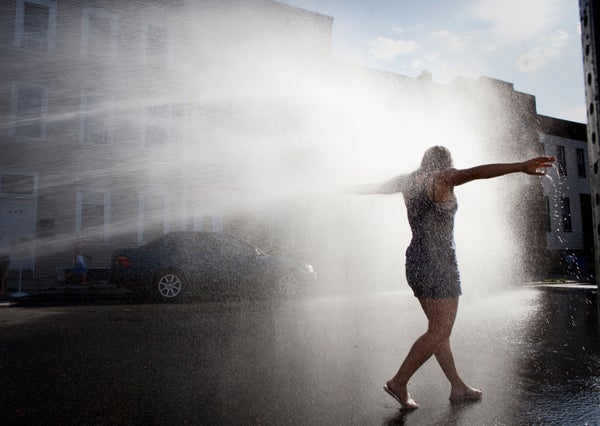
As many as 3,331 people annually could die from heat waves by 2080 in New York City alone if no steps are taken to adapt to warming temperatures and reduce emissions, a new study warns.
The report comes at the same time as a separate analysis tracing climate change and air pollution’s effects on children. Together the studies, both out of Columbia University, lay out the case for cutting carbon now.
“We now know a great deal about the harm from the emissions from fossil fuels,” said Frederica Perera, director of the Columbia Center for Children’s Environmental Health at the Mailman School of Public Health. “We know a great deal about how to reduce our dependence on fossil fuels.”
On supporting science journalism
If you're enjoying this article, consider supporting our award-winning journalism by subscribing. By purchasing a subscription you are helping to ensure the future of impactful stories about the discoveries and ideas shaping our world today.
The studies, published online this week in the journal Environmental Health Perspectives, come as the Obama administration is making a concerted effort to link efforts to tackle climate change with protecting public health.
As temperatures rise, more people may die as strokes and heart attacks become more frequent and breathing ailments get worse. But in a city as large and diverse as New York, the relationship isn’t so simple.
“Many studies keep population constant, which is not really adequate,” explained Elisaveta Petkova, project director at the National Center for Disaster Preparedness at Columbia University’s Earth Institute.
Demographics within a city change over time, which alters the risk profile. The elderly and the very young are especially vulnerable to extreme heat events, which are poised to become more frequent and intense (ClimateWire, June 14).
On the other hand, better infrastructure and access to cooling can reduce the harm from heat, and over time individuals may become acclimated to higher temperatures. “People become more resilient to heat,” said Petkova. “We don’t know exactly why.”
Petkova, who was the lead author of her study, traced five different demographic models for New York City that drew on past trends. She and her team then projected excess deaths from heat under a low and a high greenhouse gas emissions scenario, incorporating adaptation patterns.
“Aging of the population is probably the most important trend, since older adults are more vulnerable to heat-related health effects,” said co-author Patrick Kinney, a professor of environmental health sciences at Columbia University, in an email.
The results showed that higher greenhouse gas emissions would lead to more annual fatalities from heat across the city as far out as the 2080s. In one scenario, presuming no adaptation to heat and more people migrating to the city, the low-emissions profile projected 1,552 heat-related deaths per year in the 2080s, while the high-emissions model showed 3,331 deaths from heat, more than double.
“This study just highlighted how important it is to take proactive measures to reduce greenhouse gas emissions,” Petkova said.
In utero impacts
In the other paper, Perera highlighted how fossil fuel combustion has direct health consequences for children.
“Often, we think of climate change and air toxics in terms of effects on adults,” she said. “Those effects are not universal, and not enough emphasis is placed on children, who are more vulnerable.”
Many sources of carbon dioxide, like cars, factories and power plants, also produce harmful products like volatile organic compounds and polycyclic aromatic hydrocarbons.
The combination of rising temperatures from climate change and environmental pollution can have devastating effects on the very young, starting in utero. The combined effects can lead to premature birth and neurodevelopmental problems, some of which can take years to manifest themselves.
“These effects don’t disappear and persist through the child’s life course,” said Perera.
However, addressing air pollution and climate change would drastically improve health outcomes and boost the economy. U.S. EPA estimated that the value of avoided deaths due to air pollution restrictions would add up to $2 trillion in 2020.
Reprinted from Climatewire with permission from Environment & Energy Publishing, LLC. www.eenews.net, 202-628-6500
