
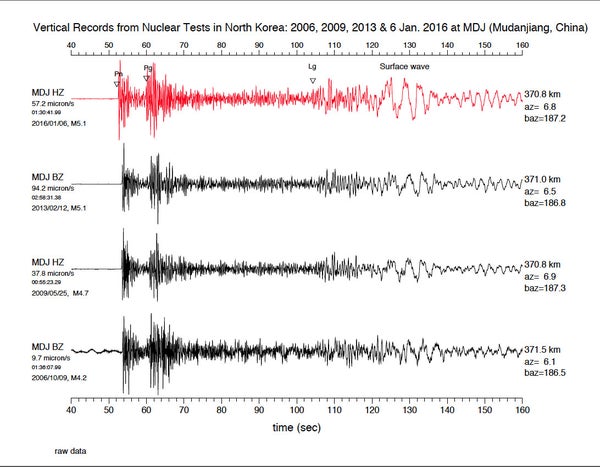
North Korea’s nuclear threats reached new heights when the country claimed to have successfully tested a hydrogen bomb underground on Tuesday night. Regional measurements confirmed a seismic event took place in North Korea, but the estimated size of the disruption cast doubt that the secretive nation had in fact detonated a thermonuclear weapon. Such a device would be hundreds of times more powerful than the bombs Pyongyang detonated during its previous three nuclear weapon tests. The estimated size of this disruption is about the same as those from previous tests, however.
Researchers can estimate the yield of a nuclear explosion based on the amplitude of the seismic waves it creates. Data collected at a Global Seismographic Network Station in Mudanjiang, China, however, suggest roughly a 3.4- to seven-kiloton blast, says Won-Young Kim, a senior research scientist at Columbia University’s Lamont–Doherty Earth Observatory. (A kiloton is equal to 1,000 tons of TNT.) Kim calculated this yield based on the magnitude 5.1 body waves the detonation sent rippling through Earth. This was more powerful than North Korea’s previous nuclear test, a 2.2- to four-kiloton blast in 2013 that set off waves equivalent to a magnitude 4.5 to 4.7 earthquake, but not nearly enough to confirm the use of a thermonuclear bomb.
Researchers have difficulty quantifying the exact size of North Korea’s nuclear detonations because the depth of the explosive device, properties of the rock surrounding the explosion and other factors influence the seismic measurements produced, Kim says. North Korea does not publicize the depth of its tests, although the material at the test site in Punggye-ri is thought to be hard granite.
On supporting science journalism
If you're enjoying this article, consider supporting our award-winning journalism by subscribing. By purchasing a subscription you are helping to ensure the future of impactful stories about the discoveries and ideas shaping our world today.
Nuclear weapons such as the bombs dropped by the U.S. on Japan to end World War II in 1945 rely on fission for their power. A thermonuclear weapon, or hydrogen bomb, uses a nuclear fission reaction to ignite a secondary hydrogen fusion reaction that makes greater use of the weapon’s atomic fuel, typically uranium or plutonium. To provide some perspective on the difference between the two: the U.S.’s first successful H–bomb test in 1952 produced an estimated yield equivalent to more than 10 megatons (10 million tons) of TNT, about 500 times more powerful than the bomb dropped on Nagasaki just seven years earlier.
Even if North Korea’s latest test was at the high end of Kim’s estimates, 0.007 megatons of TNT is a far cry from thermonuclear.