
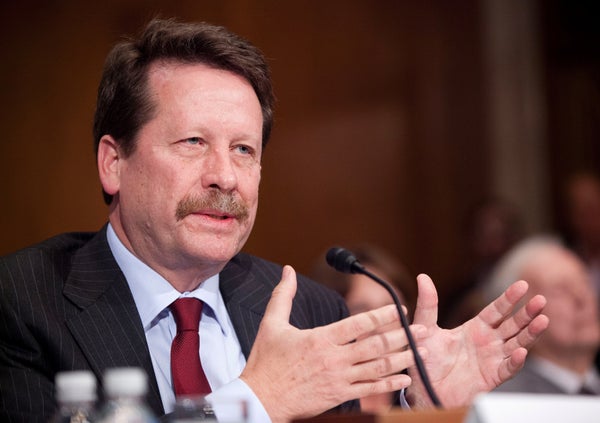
After a five-month delay, the US Senate is finally poised to vote on the nominee to head the US Food and Drug Administration (FDA), cardiologist and clinical trials expert Robert Califf.
On February 22, lawmakers voted to limit debate on Califf's nomination. That procedural tactic sets the stage for a final vote this week that would determine whether he will lead the FDA.
President Barack Obama nominated Califf in September, but a handful of lawmakers has delayed consideration of the nomination over concerns about the FDA's recent approval of genetically engineered salmon for use as food and the agency's handling of the ongoing opioid abuse crisis.
On supporting science journalism
If you're enjoying this article, consider supporting our award-winning journalism by subscribing. By purchasing a subscription you are helping to ensure the future of impactful stories about the discoveries and ideas shaping our world today.
Another lawmaker, Senator Bernie Sanders—a Democrat from Vermont who is running for president—has objected to Califf himself. Sanders finds fault with Califf's many connections to the pharmaceutical industry, which he forged over years of heading a major clinical trials centre at Duke University in Durham, North Carolina, before he joining the FDA last February.
In a recent article in the New England Journal of Medicine, Califf listed over a dozen pharmaceutical companies in his conflict-of-interest disclosure. No previous FDA commissioner has been so closely tied to the pharmaceutical industry, says Michael Carome, director of the health research group at Public Citizen, a consumer activist group in Washington DC. “It would be dangerously naïve to think he has not developed deeply ingrained attitudes that tilt in favor of the medical device and drug industries,” says Carome.
But Califf’s supporters say he has maintained his independence. “I’ve never experienced a situation where I thought he was not reporting the results of the studies in a fair, open, and honest way,” says cardiologist Steven Nissen of the Cleveland Clinic in Ohio, who has been critical of the influence the pharmaceutical industry wields on the FDA.
Smooth sailing?
After today's procedural vote, the Senate is expected to confirm Califf in a matter of days.
Daniel Carpenter, a social scientist at Harvard University in Cambridge, Massachusetts, says that Califf's nomination will likely not be the last that sparks debate over potential industry influence in government.
“The fact that [Califf] was officially at Duke but had all of these ties with industry shows how intertwined the biomedical complex has become with universities,” Carpenter says. “Future appointments from universities to the FDA and other agencies are increasingly going to be appointments from people who have these conflicts of interest.”
In 2013 and 2014, Califf received a total of US$52,000 from industry partners, primarily for travel and consulting, according to the government’s Open Payments database. About 55% of all full professors at US medical centers have received money from industry, often as payment for consulting, notes Eric Campbell, a sociologist at Harvard Medical School in Boston, Massachusetts.
“Close relationships in academia and industry are essential to moving science forward,” Campbell says. “But the question is: is that same level of closeness necessary and appropriate regarding a government regulatory agency and the industry it is trying to regulate?” The key, he says, will be how the FDA manages Califf's potential conflicts.
Nissen points to one incident that gives him confidence in Califf's independence. In 2008, Nissen told an FDA advisory committee that the agency should require diabetes drugs to be tested for their effects on cardiovascular health in addition to their ability to lower blood sugar. It was a controversial opinion, and some experts—particularly in industry—said it would discourage the development of new diabetes drugs by making the required clinical trials prohibitively expensive.
Nissen thought he had little chance of convincing the FDA panel of his argument. But after Nissen’s talk, Califf gave his own presentation in which he voiced support for Nissen’s proposal. Later that summer, the FDA announced that it would require the extra trials for full approval of the drugs. “I could never have gotten that initiative done if there weren’t some people like Califf who would stand up and say, ‘I agree’,” says Nissen. “I’m sure he took some heat from industry.”
This article is reproduced with permission and was first published on February 22, 2016.