Oddball Planet Has 3 Sunsets

Although big as four Jupiters and hot as a broiler, it is one of the smallest and coldest worlds ever directly imaged

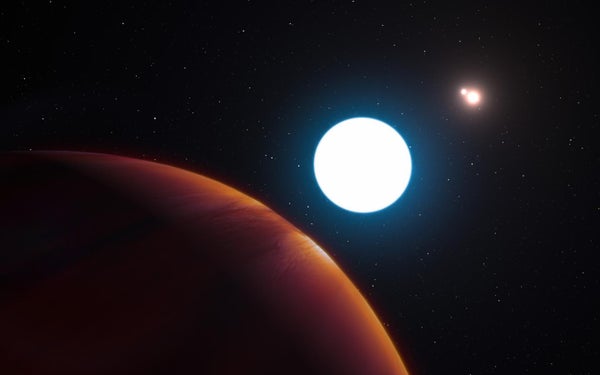
This artist's impression shows a view of the triple star system HD 131399 from close to the giant planet orbiting in the system. The planet is known as HD 131399Ab and appears at the lower-left of the picture.

Join Our Community of Science Lovers!

A bizarre solar dance has been uncovered by researchers who spotted a giant planet orbiting one of the three suns of a triple-star system.

The system was found in the constellation Centaurus, about 98 parsecs (320 light years) from Earth. As shown in an artist’s impression in this video, the planet, called HD 131399Ab, orbits the largest of the three stars. The other two stars also orbit the largest, and each other.

This is not the first planet to be found with three suns, but HD 131399Ab’s enormously wide orbit makes it unlike any other known world. The planet, which if four times the size of Jupiter, is 82 astronomical units (the distance between Earth and the Sun) from its primary star, and 300–400 astronomical units from the other two.


On supporting science journalism

If you're enjoying this article, consider supporting our award-winning journalism by subscribing. By purchasing a subscription you are helping to ensure the future of impactful stories about the discoveries and ideas shaping our world today.


A year on the planet lasts for about 550 Earth years. For the first few hundred years, when the planet is on the side of the system opposite all three stars, the team says that it will experience three sunrises and three sunsets each day. During its second ‘season’, it is in constant daylight.

Now, the researchers that detected HD 131399Ab need to wait until it has moved within the system before they can say more about its origin and fate. The planet is young, and may not remain part of the system.

“Computer simulations predict that planets in such extreme configurations can experience exotic behaviour,” says Kevin Wagner, an astronomer at the University of Arizona in Tucson, who led the study.

Such behaviour could include irregular and rapidly evolving orbits or, in more extreme scenarios, the complete ejection of the planet from the solar system.

This article is reproduced with permission and was first published on July 7, 2016.

First published in 1869, Nature is the world's leading multidisciplinary science journal. Nature publishes the finest peer-reviewed research that drives ground-breaking discovery, and is read by thought-leaders and decision-makers around the world.

More by Nature magazine

It’s Time to Stand Up for Science

If you enjoyed this article, I’d like to ask for your support. Scientific American has served as an advocate for science and industry for 180 years, and right now may be the most critical moment in that two-century history.

I’ve been a Scientific American subscriber since I was 12 years old, and it helped shape the way I look at the world. SciAm always educates and delights me, and inspires a sense of awe for our vast, beautiful universe. I hope it does that for you, too.

If you subscribe to Scientific American, you help ensure that our coverage is centered on meaningful research and discovery; that we have the resources to report on the decisions that threaten labs across the U.S.; and that we support both budding and working scientists at a time when the value of science itself too often goes unrecognized.

In return, you get essential news, captivating podcasts, brilliant infographics, can't-miss newsletters, must-watch videos, challenging games, and the science world's best writing and reporting. You can even gift someone a subscription.

There has never been a more important time for us to stand up and show why science matters. I hope you’ll support us in that mission.

Thank you,

David M. Ewalt, Editor in Chief, Scientific American

Subscribe