
Editor's note: This story was updated on September 27, 2018, to state that Thomas Gernon studied earthquakes in Oklahoma while the new research was global in nature.
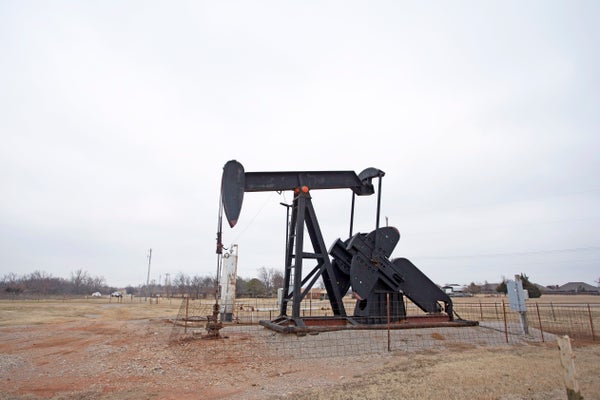
When oil and gas companies drill wells on land, the technique they use to avoid unleashing earthquakes can actually create powerful tremors, according to a new study. Those tremors seem to travel even further from the well than do the types of quakes that drillers are trying to forestall.
Drillers at thousands of wells shoot wastewater from their operations into shallow layers of porous, soft sedimentary rock; such injections are supposed to be safer than forcing the water into deeper “basement” rock layers where it might lubricate pre-existing faults, causing them to slip and trigger a powerful quake. But in a study published in the August 31 issue of Science, geologists looked at 18 drill sites in Australia, the U.S., France, Germany and Switzerland, and found that, to their surprise, the shallower sedimentary injections often caused widespread, more energetic quakes. Such tremors, seen at all 10 sites that used sedimentary injections, were as powerful as magnitude 4.7 and could reach at least six miles away from the original well. Basement injection site quakes, in contrast, topped out at just over magnitude 2.0 and could not be detected more than two thirds of a mile away.
On supporting science journalism
If you're enjoying this article, consider supporting our award-winning journalism by subscribing. By purchasing a subscription you are helping to ensure the future of impactful stories about the discoveries and ideas shaping our world today.
“The data, empirically, is quite clear: If you look worldwide at sedimentary rock injections, you can see they reach farther and create bigger earthquakes,” says geologist Emily Brodsky, a professor of earth and planetary sciences at the University of California, Santa Cruz and co-author of the new study. She says the results strongly indicate that pushing water into sedimentary rock is not safer than injecting into the basement layers.
The people doing the drilling defend present standards for wastewater injection, however. Seth Whitehead, a project manager for Energy In Depth, a pro–oil and gas drilling outreach group sponsored by the Independent Petroleum Association of America, says “there is nothing new in this study that warrants added public alarm.” He notes that there has been a marked reduction in induced quakes in the United States since 2015 and suggests that “current wastewater injection practices are safe.” Indeed, another study from Science, published in March, found that shallower injections were tied to quakes that released less energy than did injections into deeper rocks.
In addition to avoiding deep faults, sedimentary layers are attractive targets for wastewater because they are more porous and permeable than deeper rocks and can take in a lot more fluid, says Jeremy Boak, the director of the Oklahoma Geological Survey. He explains that some sedimentary rock units in his state, such as one called the Arbuckle, take in water “like a vacuum.” Both safety and storage capacity are the reasons why “right now, probably no one is injecting into the basement,” he says.
But the new research, conducted by Brodsky and fellow UC Santa Cruz geologist Thomas Göebel, indicates that sedimentary injections are not risk-free. The reason, the scientists say, is that when sedimentary layers are injected with wastewater, they expand under the increased pressure. This deformation is known as poroelasticity, a phenomenon that seismologists have implicated before in other earthquake scenarios. Scientists suspect this injection-triggered expansion conveys stress to faults far from the well, and at various depths, including faults within basement rocks. This produces distant earthquakes, unlike the shorter-range effects of injections into basement rocks.
The data in this new study do show that sedimentary rock injection appears surprisingly hazardous, says Thomas Gernon, an associate professor in Earth science at the University of Southampton and an author of the March Science study. His March work, he says, was based on tightly-clustered sites in Oklahoma. The new UC Santa Cruz research has the advantage of using several locations around the globe with varied geology, he says, which provide new insights into the mechanisms behind induced earthquakes.
The UC Santa Cruz study does have some limitations, scientists say. Though poroelasticity is the most logical explanation for the larger seismic hazard, Brodsky and Göebel did not directly detect any poroelastic changes. To nail down the cause-effect connection, researchers need to observe isolated wells with instruments that could measure changes in the ground’s shape, orientation and gravity over time.
To do so, Brodsky would like to update some experiments done in the 1970s that took steps towards understanding geological processes like these. In an oil field in Rangely, Colorado, scientists used fluid injection to generate artificial earthquakes and gathered seismic information from the temblors. But the experiments had a limited run, leaving many questions unanswered. Brodsky thinks that a new Rangely-like experiment, using up-to-date monitoring equipment, could catch poroelasticity in the act.