

By Heide Brandes
OKLAHOMA CITY, Jan 10 (Reuters) - Earthquakes in Oklahoma in the past week, including one of the strongest ever recorded in the state, have led to calls for the governor to make changes to oil and gas drilling regulations and reduce seismic activity scientists link to the energy industry.
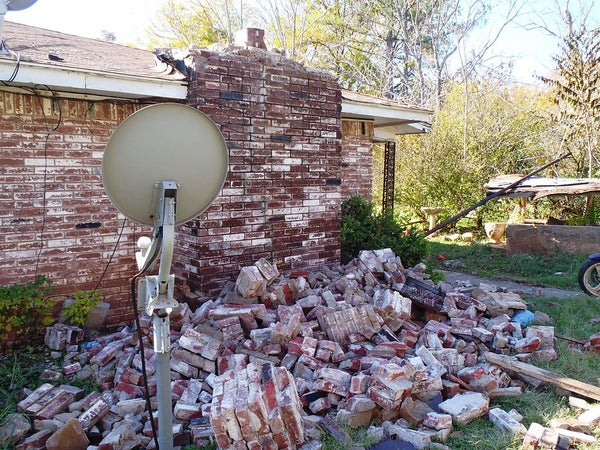
Two large earthquakes were recorded in northwest Oklahoma on Wednesday, including a magnitude 4.8 quake. The quakes were part of a surge in seismic activity over the past several years.
On supporting science journalism
If you're enjoying this article, consider supporting our award-winning journalism by subscribing. By purchasing a subscription you are helping to ensure the future of impactful stories about the discoveries and ideas shaping our world today.
Scientists have tied a sharp increase in the intensity and frequency of quakes in Oklahoma to the disposal of saltwater, a byproduct of oil and gas extraction, into deep wells. Oil fields have boomed in Oklahoma over the past decade thanks to advances in hydraulic fracturing and horizontal drilling.
State Representative Richard Morrissette, a Democrat who has said the state's Republican leaders are not doing enough to address the problem, will host a public forum at the Capitol on Friday to discuss the rash of earthquakes.
He wants the state to halt operation of injection wells at quake sites and do more to prevent them from causing quakes.
"No one in a position of authority is taking this seriously," said Morrissette, who accused the state's leadership of bowing to pressure from the energy industry.
Morrissette is hoping to build grassroots support to take on the oil and gas drilling industry, a powerful player for decades in the state and a major source of employment.
The industry is Oklahoma's largest source of private capital spending and tax revenue and accounts for about 10 percent of the state's annual economy, according to the Oklahoma State Chamber, which represents more than 1,000 Oklahoma businesses.
Although the quakes last week caused no major reported damage or injuries, they left many Oklahomans shaken. Firms providing quake insurance saw a surge in calls inquiring about coverage.
"We don't have overall data on how much injection is going on in this area, but we attribute most of the earthquakes these days to deep injection of produced oil wastewater," said Jerry Doak, director of the Oklahoma Geological Survey.
State leaders have been instituting changes, but critics said they have not gone far enough.
In response to the quakes, Governor Mary Fallin, a Republican, said last week that the state has been regulating disposal wells, taking some steps to limit their injection rate and depth of their injections.
"Science is ever-evolving as to what actually causes earthquakes. We know that disposal wells can cause earthquakes, but not all earthquakes. There are fault lines that are just natural in Oklahoma," she told The Oklahoman newspaper.
Energy companies have also been responding.
Phillips 66 has overhauled how it plans for earthquakes, a sign U.S. energy companies are starting to react to rising seismicity around the world's largest crude storage hub in Cushing, Oklahoma, site of many disposal wells.
The changes include new protocols for inspecting the health of crude tanks, potentially halting operations after temblors, and monitoring quake alerts.
The strongest quake recorded in Oklahoma was a magnitude 5.5 that struck in April 1952, the U.S. Geological Survey said. (Reporting by Heide Brandes; Writing by Jon Herskovitz; Editing by Cynthia Osterman)