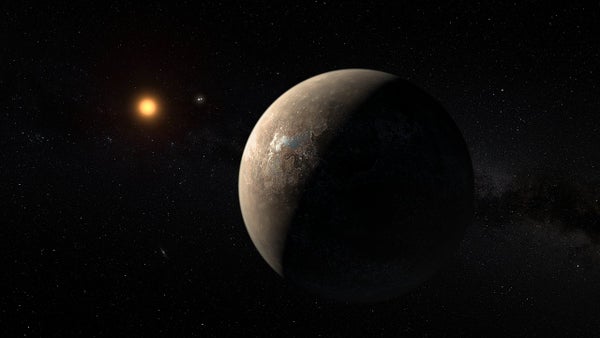
The world of science news was recently abuzz with an incredibly exciting new discovery—a roughly Earth-mass planet orbiting the star Proxima Centauri a mere 4.2 lightyears away. The discovery has been described as an “astronomy dream come true.”
As shocking as it sounds, we find exoplanets, or planets orbiting stars other than our Sun, all the time now. We know of nearly 3,000 such planets plus another 2,500 planet candidates. So what makes this recent discovery, dubbed Proxima b, so particularly exciting? Not only is this newfound planet very similar to the Earth in mass at 1.3 times the mass of the Earth, but it also orbits its host star in that star’s habitable zone.
On supporting science journalism
If you're enjoying this article, consider supporting our award-winning journalism by subscribing. By purchasing a subscription you are helping to ensure the future of impactful stories about the discoveries and ideas shaping our world today.
As we’ve previously discussed, the habitable zone describes the range of distances from a star with the right temperature for liquid water to exist. You can think of the habitable zone as a band or torus around the host star. Planets too close to the star will have temperatures that are too high, causing any liquid water to boil while planets too far from the star will be too cold leading to frozen worlds. Planets within the habitable zone—also called the “Goldilocks zone”—have temperatures that are “just right” and thus at least have the potential to host liquid water.
If you enjoyed this article, I’d like to ask for your support. Scientific American has served as an advocate for science and industry for 180 years, and right now may be the most critical moment in that two-century history.
I’ve been a Scientific American subscriber since I was 12 years old, and it helped shape the way I look at the world. SciAm always educates and delights me, and inspires a sense of awe for our vast, beautiful universe. I hope it does that for you, too.
If you subscribe to Scientific American, you help ensure that our coverage is centered on meaningful research and discovery; that we have the resources to report on the decisions that threaten labs across the U.S.; and that we support both budding and working scientists at a time when the value of science itself too often goes unrecognized.