
Seeding the Sky
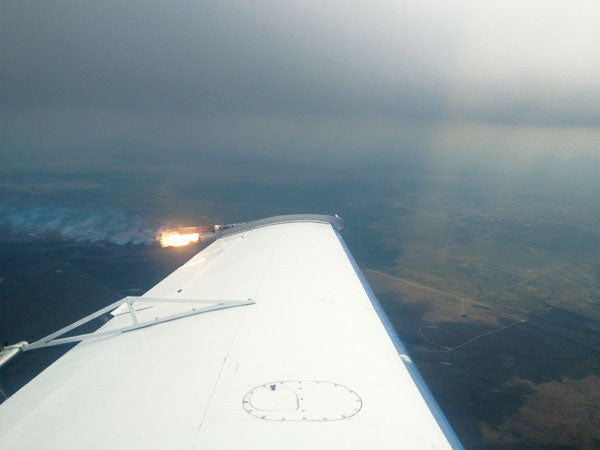
The most widely used weather-modification technique is probably cloud seeding, which involves priming clouds with particles of silver iodide. (The compound is what’s inside the wing-mounted flares shown here.) Once those silver iodide particles make their way into a ripe cloud, they collide with drops of supercooled water and form ice; the ice then falls to the ground, melting along the way. Despite its dubious reputation, new science suggests that under the right circumstances, cloud seeding does indeed work. As Roelof Bruintjes, a physicist with the National Center for Atmospheric Research, told Dan Baum for his recent article on cloud seeding the July Scientific American, “The evidence is strong that under certain conditions, we can increase rainfall by 10 to 15 percent.”
Rain Rockets
Airplanes aren’t the only way to seed clouds. China’s massive weather-modification program includes a battery of 5,000 rocket launchers, which fire particles into puffy clouds in attempt to draw rain.
On supporting science journalism
If you're enjoying this article, consider supporting our award-winning journalism by subscribing. By purchasing a subscription you are helping to ensure the future of impactful stories about the discoveries and ideas shaping our world today.
The Atmosphere Zapper
In Abu Dhabi the company Meteo Systems is attempting to pull rain from the sky with electricity. The theory is that electrified, umbrella-shaped towers can send negatively charged particles into the air, increasing the chance that supercooled droplets will collide with freezing nuclei, thus becoming rain. Experts, however, are highly skeptical.
Ice-Breaking Booms
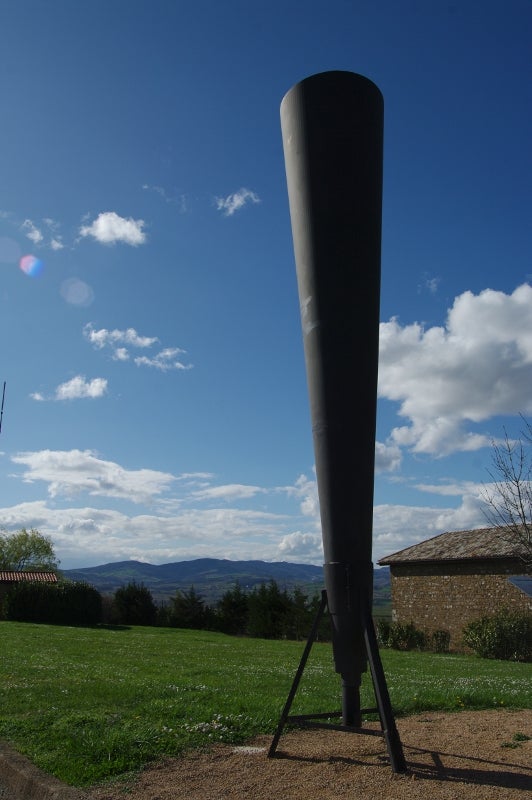
French winemakers and other agriculturists have long used hail cannons to try to save their fruit from storm damage. Every few seconds an explosion in the cannon’s lower chamber sends a loud boom skyward; the thinking is that the resulting shock waves will break up the ice before it reaches the ground. There is, of course, little evidence that hail cannons actually work.
Riding the Lightning
As unlikely as it sounds, researchers around the world have tried to redirect lightning by taking a long wire, tying one end to the ground and the other to a rocket, then firing the rocket into a thunderstorm. More recent, promising developments include research at the University of Arizona in Tucson that shows high-intensity lasers could redirect lightning.
