
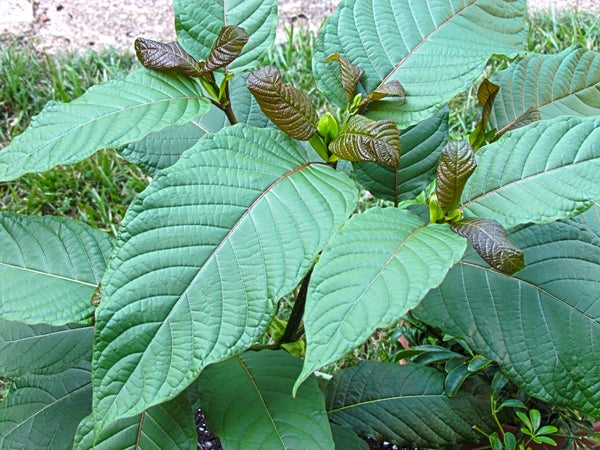
For recreational drug users looking for an opioidlike high without the legal problems of heroin, fentanyl, and oxycodone, the Southeast Asian plant called kratom (Mitragyna speciosa) has provided an attractive alternative. But, acting on anecdotal reports of people becoming dependent on kratom, six states, including Vermont and Indiana, have banned the sale and use of the herb.
A new study provides some data to support those states’ concerns (J. Am. Chem. Soc. 2016, DOI:10.1021/jacs.6b00360). A team of researchers shows for the first time that kratom’s primary constituent, mitragynine, and four related alkaloids bind to and partially activate human µ-opioid receptors (MORs), the primary targets of strong opioids in the brain, spinal cord, and gastrointestinal tract.
The most potent of the related alkaloids was the mitragynine oxidation product 7-hydroxymitragynine. Its MOR potency was one-tenth that of morphine, while mitragynine’s was one-hundredth.
On supporting science journalism
If you're enjoying this article, consider supporting our award-winning journalism by subscribing. By purchasing a subscription you are helping to ensure the future of impactful stories about the discoveries and ideas shaping our world today.
“Mitragynine is not a particularly very potent opioid,” says Dalibor Sames, a chemist at Columbia University who led the team. But, he says, it’s possible that the plant provides a high enough dose of the compound to overcome that weak potency. “The plant is designed to be a factory for mitragynine,” Sames says. Mitragynine can amount to almost two-thirds of the alkaloid extract from a kratom leaf, adds Andrew C. Kruegel of Columbia, who is the paper’s first author.
Kelly M. Standifer, professor and chair of pharmaceutical sciences at the University of Oklahoma, points out that the researchers tested the compounds’ potency in nonneuronal cells forced to express the receptors. The molecules could be more potent in actual brain tissue, so these findings may not fully capture the risks of kratom, she says.
Previous studies had suggested the plant itself produced 7-hydroxymitragynine. Sames says the team could detect it by mass spectrometry, but only at very low concentrations. Instead, the team demonstrated that sunlight and oxidizing conditions can convert about half of the mitragynine in solution to 7-hydroxymitragynine. And sunlight alone can convert about 8% of the mitragynine. Therefore, the team concluded that storage conditions can affect the potency of an extract by increasing the amount of the oxidized alkaloid.
Further experiments on the kratom alkaloids showed that when they activate MORs, the receptors turn on pathways independent of a protein called β-arrestin. Previous studies have shown that the β-arrestin pathway mediates many of the undesirable effects of traditional opioids such as constipation, respiratory depression, and the development of tolerance. So drugmakers have been trying to develop opioids that don’t recruit β-arrestin in hopes of finding painkillers with fewer side effects.
Sames noted that their findings could fuel the design of other, safer opioid painkillers.
This article is reproduced with permission from Chemical & Engineering News (© American Chemical Society). The article was first published on June 3, 2016.
Editor's Note (6/8/16): This story was posted with the wrong byline; it has since been corrected.

