
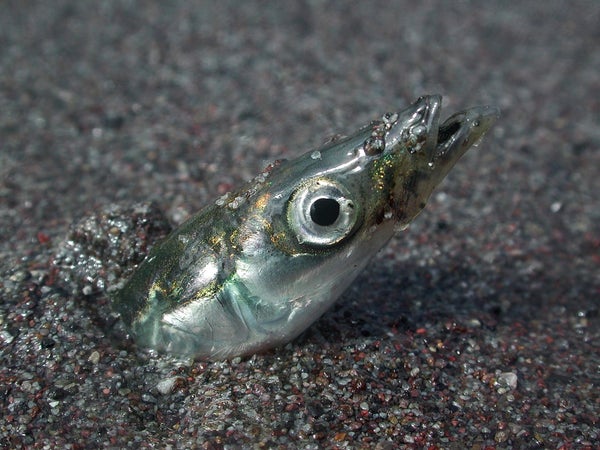
Atlantic saury, pearlsides, sand lances—you’ve probably never tasted any of these fish (or heard of them). But they and other “forage” species play a vital role in our oceans—they’re food for the fish we eat. In fact, these lowly forage species are so essential to the health of marine ecosystems that some people are taking extra steps to protect them—especially as the global demand for seafood soars. Last week the Mid-Atlantic Fishery Management Council, which oversees fishing in U.S. waters from New York State to North Carolina, decided to start managing more than 50 species of forage fish.
The council’s decision is a bit unusual—after all, none of the forage fish populations are in danger of collapse, and only one of the 50-plus species is harvested on a large scale in the mid-Atlantic today. In the region, people have mostly ignored these fish because they tend to be small, low-value and not very appetizing.But the council is trying to handle its fisheries more holistically because it has realized that putting controls on a single species at a time just will not work. “There's a move now to manage all fisheries as part of a bigger system,” says Steve Ross, a research professor at the University of North Carolina Wilmington who is one of the council’s scientific advisors. “When you manage one fish, you try to manage its whole environment—and that includes the food web.”
These small, nutrient-rich forage fish pump energy through the ecosystem in a way that no other marine animal can. They feed on the bottom of the food chain—on single-celled plankton, which larger fish cannot eat—and then they become prey for all sorts of upper-level predators like tuna, sea bass and halibut as well as seabirds and marine mammals. “I like to say that forage fish help turn sunlight into salmon,” explains Ellen Pikitch, a professor of marine biology at Stony Brook University. “They support so much of the ocean ecosystem.”
On supporting science journalism
If you're enjoying this article, consider supporting our award-winning journalism by subscribing. By purchasing a subscription you are helping to ensure the future of impactful stories about the discoveries and ideas shaping our world today.
The council also made its decision because it is concerned that as people around the world eat more seafood than ever, demand for mid-Atlantic forage fish will grow. That’s because, increasingly, people rely on aquaculture (fish farms) to meet their seafood needs. And enormous quantities of forage fish are caught worldwide and processed into fish meal and fish oil that is used as fodder for farmed fish. The council decided to be proactive and regulate forage catch in case mid-Atlantic fishermen start targeting these fish in a big way.
This is a smart move, scientists say, because if humans ever wipe out forage species, it will be catastrophic for both the ocean and us. The many marine animals that depend on them would lose their food source, predator fish populations would fall and the effects would likely ripple throughout the entire food web, hurting organisms that don’t even rely on those fish directly. “If you take too many forage fish out,” Pikitch says, “you risk pulling the rug out from under the ocean ecosystem.”
Not only would this be terrible for the marine environment, it also would undercut fishermen who target big-money fish like cod or tuna—the fish we actually like to eat. “Someone could just go over with a net, catch a shitload of these fish and screw me out of the tuna fishery,” says council member John McMurray, who owns a charter fishing business in New York.
The Mid-Atlantic Council intends to limit a boat’s haul of forage fish to 1,700 pounds each time it goes out to sea. That is not a huge catch, but mid-Atlantic fishermen today rarely harvest more than that. “It’s almost the highest amount of what has been caught in the past,” explains Julia Beaty, a fishery management specialist for the council. “The thought was that that number wouldn’t be overly burdensome on existing fisheries.”The council’s decision is not in effect, yet; the Secretary of Commerce still needs to approve it before it becomes regulation.
The council will also consider expanding fisheries for forage species if there is scientific evidence that fishermen can do it sustainably. This is a big shift from how people have built fisheries in the past. “Before, fisheries developed pell-mell and then we sorted out the impact after the fact,” says Rich Seagraves, a senior scientist for the council. “Now we’re shifting the burden of proof. If you’re in the business and you want to ramp up a new fishery, you need to prove there won’t be significant negative effects on the ecosystem.”