
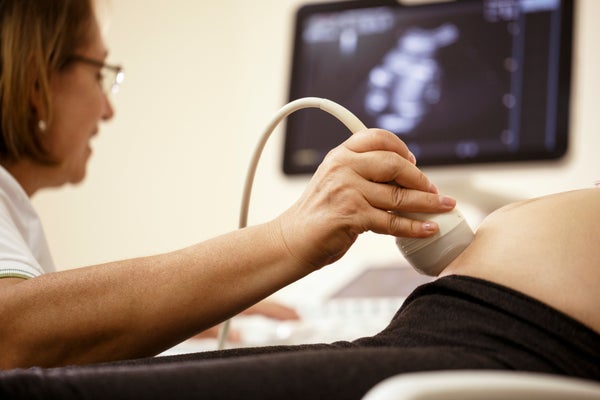
Suspicions of a link between prenatal ultrasound scans and autism spectrum disorder are nothing new. The technology has exploded in recent decades, giving expectant parents more detailed images of their developing offspring than ever before. And as ultrasound use has sharply increased, so too have diagnoses of autism—prompting questions about a potential relationship.
A rigorous new study examining the association between ultrasounds during the first or second trimester of pregnancy and later development of autism spectrum disorder, however, delivers some good news. The study, which analyzed the medical records and ultrasound details of more than 400 kids who were born at Boston Medical Center, found there was no increase in the number of prenatal scans or duration of ultrasound exposure in children with autism compared with kids with typical development or separate developmental delays. In fact, the group with autism had less average exposure time during its first and second trimesters of development than individuals without autism did. The finding adds weight to earlier studies that suggested such scans—which use high-frequency sound waves to create an image of the fetus, placenta and surrounding maternal organs—are not a powerful enough environmental risk to cause autism on their own.
But the new study, published Monday in JAMA Pediatrics, did leave one question unanswered: Does the depth of the actual ultrasound scan make a difference? The work found the children with autism were exposed to prenatal ultrasounds with greater penetrationthan the control group: During the first trimester, the group with autism had scans with an average depth of 12.5 centimeters compared with 11.6 centimeters for the control group. And during the second trimester the group with autism had scan depths of 12.9 centimeters compared with 12.5 centimeters for the typical development control group. Ultrasounds may not be uniform for reasons including the position of the fetus in the womb.
On supporting science journalism
If you're enjoying this article, consider supporting our award-winning journalism by subscribing. By purchasing a subscription you are helping to ensure the future of impactful stories about the discoveries and ideas shaping our world today.
Perhaps, the authors wrote, greater ultrasound depth could result in more harmful exposure to energy emissions—potentially causing damage to the developing fetuses’ cells and brains. Yet the authors themselves cautioned there is not enough evidence in humans to draw that conclusion and that further, larger studies should be launched to explore that relationship. Moreover, they noted, a variety of elements including the mother’s body mass index, gestational diabetes and aspects of ultrasonographic exposure—including depth—might be intertwined.
Sara Jane Webb, an associate professor of psychiatry and behavioral sciencesat the University of Washington, wrote in an accompanying editorial in JAMA Pediatrics that she is not convinced the deeper ultrasound wave penetration is a concern. On balance, she told Scientific American, the increased depth would likely not be significant enough to outweigh the fact that the group with autism had less ultrasound exposure time. “We think there are probably fetuses vulnerable to autism due to genetic errors and environmental factors,” she says. “But this study does not provide any additional support for ultrasound being a single cause.”
