
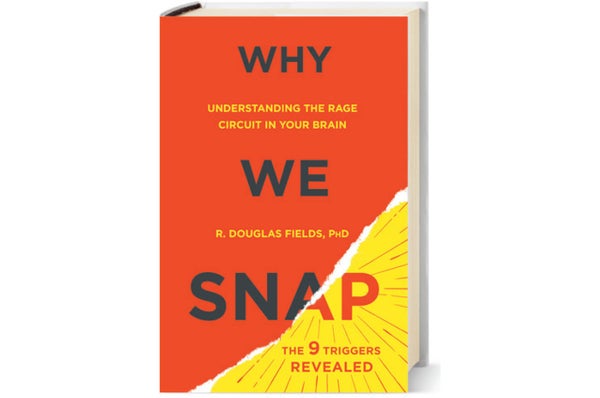
Seeing Red: Why We Snap: Understanding the Rage Circuit in Your Brain
by R. Douglas Fields
Dutton, 2016 ($28)
Everyone gets angry. We curse under our breath when another driver cuts us off. Or grumble about our neighbors when they make a lot of noise. But what causes tempers to erupt with such intensity that we lash out beyond all reason? What makes some people “go postal” and become homicidal seemingly within seconds? In Why We Snap, neuroscientist and Scientific American Mind advisory board member Fields takes readers on a journey into the brain's so-called rage circuit to untangle how this emotion works.
The book opens with an adrenalin-packed scene in which Fields and his daughter cross paths with a pickpocket in Barcelona. In almost superhuman fashion, Fields slams the thief onto the pavement, retrieves his wallet and flees through unfamiliar streets. He was so surprised by the violence and speed of his response that he spent the next four years exploring what caused it.
On supporting science journalism
If you're enjoying this article, consider supporting our award-winning journalism by subscribing. By purchasing a subscription you are helping to ensure the future of impactful stories about the discoveries and ideas shaping our world today.
After combing through news headlines, case studies and research reports, Fields homes in on nine fundamental triggers of rage: we are more prone to lose it, he says, when called to defend life and limb, honor, family, our freedom of movement, or our larger social groups, territory, mates, resources or social justice. Why We Snap describes how each of these potentially incendiary situations can “initiate an automatic rage response” and delves into the science of the fear and aggression at its root.
Perhaps Fields's most sobering conclusion is that, under the right circumstances, absolutely anyone, from grandmothers to ex-cons, can lash out violently thanks to our evolutionary past. The neural circuits that helped ancient humans protect themselves and survive also recognize and respond to dangers in our modern environment. When we sense a threat—be it a saber-toothed tiger or a social media troll—we experience flight or fight. In these moments, adrenaline floods our body, prompting a variety of physical responses that ready us to either attack or escape.
A range of brain areas, including the amygdala (our emotional center), mediates this reaction. In some, these regions become overactive or hypersensitive. Chronic stress or trauma, in particular, “literally rewires the rage circuits,” Fields writes, making those affected more likely to snap, even at minor provocations. Interestingly, he notes that the brain circuitry behind rage behaviors can also prove beneficial. U.S. Navy SEALs, for instance, are trained to harness the emotional rushes associated with rage to pull off heroic feats in the face of imminent danger.
Throughout the book, Fields recounts a steady stream of attention-grabbing, gruesome stories of enraged individuals. About a third of the way in, he begins to jump back and forth between these anecdotes and scientific explanations—a structure that can make the book feel disjointed. Also, the book's title misleadingly refers to a single “rage circuit,” which Fields himself explains is not the reality—numerous brain regions regulate our anger response. But for those craving an action-packed account of what scientists currently know about how rage works, this book delivers.