
Sight begins with light. Look around and everything you perceive is the result of particles of light bouncing off surfaces and traveling to your eyes. For millennia visual artists have played tricks with light and shadow to mimic, capture and occasionally subvert the same rules that let you take in the world.
Perceptual scientists V.S. Ramachandran and Chaipat Chunharas at the University of California, San Diego, have developed dozens of demonstrations to identify and explore these rules. In the July/August issue of Scientific American MIND they present a series of illustrations that demonstrate the power of shading, one of the most elementary elements of perception.
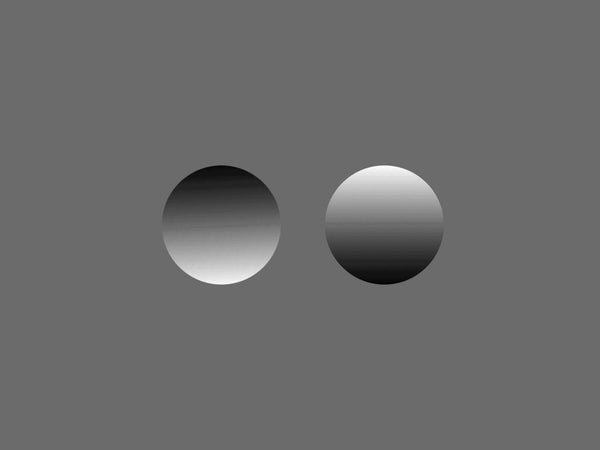
For an example, watch the gif below for a few seconds. What do you see?
On supporting science journalism
If you're enjoying this article, consider supporting our award-winning journalism by subscribing. By purchasing a subscription you are helping to ensure the future of impactful stories about the discoveries and ideas shaping our world today.
When Ramachandran and Chunharas created this animation, they made use of just two circles, side by side. The circles were shaded in opposite ways and alternated in presentation. The researchers expected people might perceive the display as two convex spheres with alternating lighting; two disks that continuously morphed from a concave into a convex shape; or—very literally—a convex sphere and a cavity trading places.
Instead, in an unpublished study with 15 participants, a majority of people reported seeing something like this (although in much more rapid motion):
That is to say, people reported seeing a ball-like sphere that moved back and forth between two cavities. This illusion disappeared, however, when the scientists simplified their animation to remove any shading gradient.
The simpler display makes it clear that shading and shadows are the brain’s cue to interpret a two-dimensional image as having a third dimension (something artists have long recognized). Once the brain has established it is looking at a 3-D ball or sphere, it can make assumptions about an object’s properties, such as its ability to roll back and forth between stationary cavities.
And in a variation on the experiment, the scientists created a display very similar to the initial animation but only allowed one of the two spheres to change over time.
This time people uniformly saw a sphere on the right—a bias that probably comes about because we as a species have evolved on a world littered with solid, convex objects—and an object on the left that continuously morphed back and forth from a convex into a concave shape. As Ramachandran and Chaipat detail in their article for MIND, these demonstrations can give us insight into how we process visual information and why, in evolutionary terms, we see things the way we do.