
The main goal posts in the global fight against climate change are set in the wrong place, one researcher argues in a new paper this week.
The established international target of limiting global warming to 2 degrees Celsius leaves too much wiggle room and doesn’t move the world fast enough to avert catastrophic warming, explained Oliver Geden, head of the E.U. research division at the German Institute for International and Security Affairs.
“The whole discourse on 2 degrees is focusing on targets and not action,” Geden said. “If you say 2 degrees, you’re addressing us all, which is humanity, which diffuses responsibility.”
On supporting science journalism
If you're enjoying this article, consider supporting our award-winning journalism by subscribing. By purchasing a subscription you are helping to ensure the future of impactful stories about the discoveries and ideas shaping our world today.
He made his case for setting an objective of driving carbon emissions down to zero in a commentary article published Monday in the journal Nature Geoscience.
In theory, an international temperature target gives countries a trajectory for fighting climate change. In practice, it doesn’t tell anyone much about who needs to act and what they should do.
With a temperature target, negotiators set a warming limit, calculate the maximum amount of greenhouse gas emissions that could be released without breaching that barrier and then allocate limits to countries within that carbon budget.
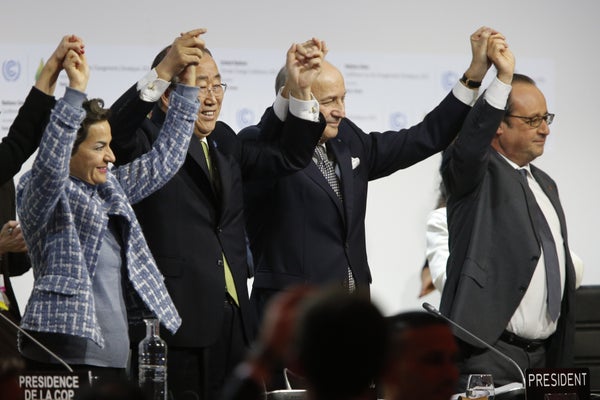
Nations meeting as part of the 21st Conference of the Parties to the U.N. Framework Convention on Climate Change (COP 21) in Paris in December set goals of keeping global temperatures below 2 C in warming, along with an aspirational target of limiting warming to 1.5 C.
However, within that framework, a country could still build a new coal power plant if it was within its carbon budget. Meanwhile, under the Paris Agreement, the intended nationally determined contributions—voluntary proposals from more than 180 countries for how they will contribute to the global climate fight—would still lead the world to overshoot the 2-degree warming limit.
To keep countries moving in the right direction, Geden said it’s better to aim for net zero greenhouse gas emissions. The Paris Agreement also included language about getting the world to net zero carbon production, but Geden said the directive was vague and ranked low in the target hierarchy.
Others call temperature target a key ‘guidepost’
Aiming for zero spreads the burden of fighting climate change across all sectors of an economy—energy, agriculture, transportation—and provides more tangible guidance for how to reduce emissions. This shifts government thinking on climate change from chipping away at a massive global threat to finding the specific individual tactics that cut emissions.
“We’re talking more about actions and not so much intentions,” Geden said. “Let’s not waste time with another round of a temperature target debate.”
With a net zero emissions target as the highest priority, it also would be easier to hold countries, businesses and citizens immediately accountable for their greenhouse gas output rather than obscuring their carbon pollution within a national goal.
Both the temperature target and the emissions target still must address equity, which remains a thorny political issue among the heavy polluters and those most threatened by climate change.
Decisions on which countries have to reduce their output, by how much and who has to go first continue to linger, but with a net zero goal, these factors would be reduced to timing: When does a country plan to peak its emissions and push them down?
However, other analysts warned against throwing out temperature goals altogether, since the ultimate goal is to keep the planet from warming too much.
“Without that guidepost, one could get to net zero hypothetically and overshoot the temperature goal,” said Kelly Levin, a senior associate at the World Resources Institute. “They both serve different roles.”
Optimism on Paris
David Victor, a professor of international relations at the University of California, San Diego, suggested that there is no single finish line for averting climate change.
In addition to temperature and emissions objectives, climate agreements should measure risk mitigation and adaptation, he said.
“What you want is a kind of dashboard of indicators of how the system overall is doing,” he said.
With COP 21 in the rearview mirror, the next step in international climate action will be bridging the centralized international climate goals with the fishermen, farmers and factory workers on the front lines of the fight against warming.
Translating lofty ambitions, whether limiting warming to a certain temperature or reaching an emissions equilibrium, into meaningful action will likely be a tough step.
“For me, I’ve always been very skeptical of the international negotiation process because it was too naive about how to get countries to start the process,” Victor said. “Everything that was really hard in Paris was delayed until later.”
But as far as massive international climate agreements go, the Paris accord was written better than most and has set the stage for gradual improvements over time as negotiators iron out the wrinkles of measuring progress and enforcing commitments, Victor said.
“Overall, I’m extremely optimistic about Paris,” he said.
Reprinted from Climatewire with permission from Environment & Energy Publishing, LLC. www.eenews.net, 202-628-6500