
By Marius Zaharia
The number of confirmed cases of Zika virus in Singapore rose to 82 on Tuesday, with some of the latest infections detected beyond the area of the initial outbreak.
Several countries advised pregnant women or those trying to conceive to avoid traveling to the city-state.
On supporting science journalism
If you're enjoying this article, consider supporting our award-winning journalism by subscribing. By purchasing a subscription you are helping to ensure the future of impactful stories about the discoveries and ideas shaping our world today.
The mosquito-borne Zika virus was detected in Brazil last year and has since spread across the Americas. It poses a risk to pregnant women as it can cause severe birth defects. It has been linked in Brazil to more than 1,800 cases of microcephaly, a rare birth defect where babies are born with abnormally small heads and brains.
At least five of 26 new cases confirmed late on Tuesday were detected outside the initial cluster in the Aljunied area in the southeast of Singapore, the health ministry and National Environment Agency (NEA) said in a joint statement.
Australia, Taiwan and South Korea issued travel warnings, and Singapore advised pregnant women to take a free Zika test if they showed any symptoms or if their partners tested positive.
"This is regardless of whether they have been to Zika-affected areas," the statement said.
The outbreak and advisories come as the tourism industry in one of the world's busiest travel hubs already faces weak global economic growth. Singapore's Tourism Board said it was premature to consider any impact on the sector, adding it remained a "safe travel destination".
More than 55 million people pass through Singapore's Changi airport every year. In the first half of this year, tourism arrivals topped 8 million, around 1 million more than a year earlier.
MOZZIE SPRAY SALES
Singapore reported its first case of locally-transmitted Zika at the weekend, and the number of confirmed infections has risen steadily since then. At least three dozen patients have made a full recovery.
Neighboring Malaysia and Indonesia have stepped up protective measures, introducing thermal scanners at airports and border checkpoints with the island state.
Singapore residents responded to government calls to be vigilant and to take precautions against mosquito bites.
Online retailer Lazada Singapore said sales of insect repellents jumped fivefold in the past three days. FairPrice supermarkets and Watsons pharmacies said their sales of such products had doubled.
Most of the early infections were among foreign workers, hundreds of thousands of whom, mainly from the Asian sub-continent, work on Singapore's construction sites and in the marine sector.
The Singapore government has not said where the infected foreign workers are from. The foreign ministry directed queries to the health ministry, which did not respond to Reuters questions on the issue. The Ministry of Manpower also did not respond to a request for comment made outside working hours.
The High Commission of Bangladesh, which represents the largest community of foreign workers, said none of those infected were Bangladeshis, and the Thai foreign ministry said none were from Thailand. The embassies of China, India, Sri Lanka and Myanmar said they had not been notified by Singapore whether their citizens were among those infected.
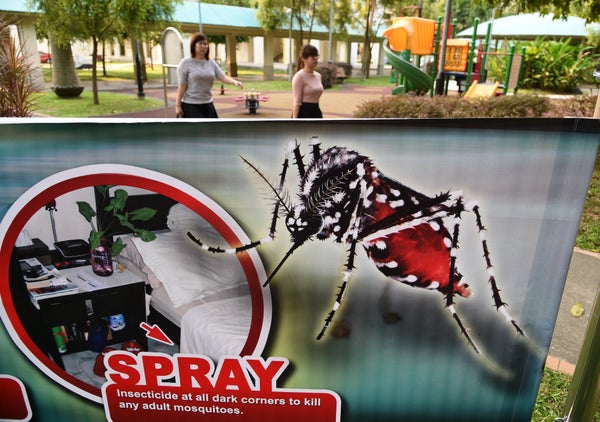
Authorities inspected thousands of homes in seven parts of Singapore, including five foreign worker dormitories, spraying insecticide and removing potential mosquito breeding habitats.
The NEA has inspected about 5,000 premises in and around the initial outbreak area, issuing 400 notices to owners of buildings they could not access. The NEA can force entry into those premises if needed.