
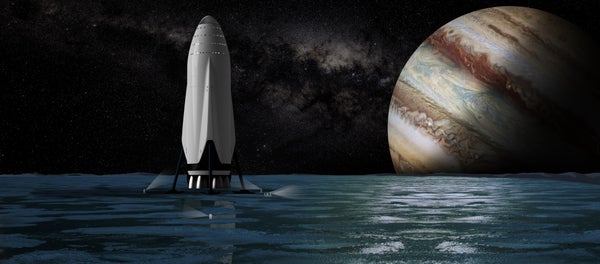
Now we know how Elon Musk plans to get 1 million people to Mars.
At a conference in Mexico today (Sept. 27), the SpaceX founder and CEO unveiled the company's Interplanetary Transport System (ITS), which will combine the most powerful rocket ever built with a spaceship designed to carry at least 100 people to the Red Planet per flight.
If all goes according to plan, the reusable ITS will help humanity establish a permanent, self-sustaining colony on the Red Planet within the next 50 to 100 years, Musk said at the International Astronautical Congress in Guadalajara. [SpaceX's Interplanetary Transport for Mars in Images]
On supporting science journalism
If you're enjoying this article, consider supporting our award-winning journalism by subscribing. By purchasing a subscription you are helping to ensure the future of impactful stories about the discoveries and ideas shaping our world today.
"What I really want to do here is to make Mars seem possible—make it seem as though it's something that we could do in our lifetimes, and that you can go," he said.
Mars transport system
The ITS rocket will be more or less a scaled-up version of the first stage of SpaceX's Falcon 9 booster, Musk said. But the 254-foot-tall (77.5 meters) ITS booster will feature 42 Raptor engines, whereas the Falcon 9 is powered by nine Merlins. When combined with its crewed spaceship, the ITS will stand a full 400 feet (122 m) high, Musk wrote on Twitter. That would make it the largest spaceflight system ever built, taller even than NASA's legendary Saturn V moon rocket.
The Raptor engine, which SpaceX recently test-fired for the first time, is about the same size as Merlin but three times more powerful, Musk said. ITS will therefore be an incredibly potent machine, capable of lofting 300 tons to low-Earth orbit (LEO)—more than two times more than Saturn V could lift. (That's for ITS's reusable version; an expendable variant could launch about 550 tons to LEO, Musk said.)
The spaceship, which sits atop the booster, will be 162 feet (49.5 m) tall and 56 feet (17 m) wide and will have nine Raptors of its own. The booster will launch the spaceship to Earth orbit, then return to make a soft landing at its launch site, which is currently envisioned to be Launch Pad 39A at NASA's Kennedy Space Center in Florida. [Fly Through SpaceX's Interplanetary Spaceship | Video]
The spaceship will lift off with little if any fuel on board, to maximize the payload—people, cargo or a combination of both—that the craft is able to carry to orbit. An ITS booster will therefore launch again, topped with a tanker, and rendezvous with the orbiting spaceship to fill its tank.
Then, when the timing is right—Earth and Mars align favorably for interplanetary missions just once every 26 months—the spaceship portion of the ITS will turn its engines on and blast from Earth orbit toward the Red Planet.
The spaceship will be capable of transporting at least 100 and perhaps as many as 200 people, Musk said. It will also likely feature movie theaters, lecture halls and a restaurant, giving the Red Planet pioneers a far different experience than that enjoyed by NASA's Apollo astronauts, who were crammed into a tiny capsule on their way to the moon.
"It'll be, like, really fun to go," Musk said. "You'll have a great time."
The powerful Raptors will allow the ship to make the trip in as little as 80 days initially, depending on exactly where Earth and Mars are at the time, Musk said. That's a pretty quick trip; it takes six to nine months for spacecraft to reach the Red Planet using currently available technology. And Musk said he eventually thinks the ITS ship will be able to cut the travel time to just 30 days or so.
There won't be just one ship making the journey. When the ITS is really up and running, 1,000 or more of the ships will zoom off to Mars every 26 months.
"The Mars colonial fleet would depart en masse," Musk said.
This fleet would land on Mars using "supersonic retropropulsion," slowing down enough to touch down softly by firing onboard thrusters rather than relying on parachutes. SpaceX said it plans to test this landing technique during the company's upcoming "Red Dragon" mission, which aims to launch SpaceX's uncrewed Dragon capsule toward Mars in May 2018.
Not a one-way trip
SpaceX also plans to build a solar-powered factory on Mars that will use the carbon dioxide and water ice in the planet's air and soil, respectively, to generate methane and oxygen—the propellant used by the Raptor engine. (Musk didn't discuss other aspects of the Mars colony; SpaceX is concentrating on the transportation architecture, reasoning that the colonists themselves will build most of the city they live in.) [SpaceX's Interplanetary Ship Could Go Beyond Mars | Video]
The ITS spaceships will be refueled on Mars and will launch back to Earth from there, meaning prospective colonists don't have to stay on the Red Planet forever if they don't want to. (Getting off Mars doesn't require a big rocket, because the planet is much smaller than Earth and therefore has a weaker gravitational pull.)
"We need the spaceship back, so it's coming," Musk said. "You can jump on board or not."
Each ITS spaceship will probably be able to fly at least a dozen times, and each booster should see even more action, Musk said. This reusability is the key component of SpaceX's plan, and should be the chief driver in bringing the price of a Mars trip—which Musk said would cost about $10 billion per person using today's technology—down to reasonable levels.
"The architecture allows for a cost per ticket of less than $200,000," Musk said. "We think that the cost of moving to Mars ultimately could drop below $100,000."
Coming soon?
Fewer than 5 percent of SpaceX's personnel are working on the ITS at the moment, Musk said. And the company is currently spending just a few tens of millions of dollars on the project every year, which Musk estimated would ultimately require a company investment of about $10 billion.
But that should change as SpaceX wraps up work on the final version of the Falcon 9 and its crewed Dragon capsule, which will carry astronauts to and from the International Space Station for NASA (and perhaps ferry folks to other destinations close to Earth), Musk said.
Within two years, Musk aims to be devoting most of SpaceX's engineers to ITS, and to be spending perhaps $300 million annually on the project. He envisions other organizations eventually aiding SpaceX in Mars colonization as well, saying the effort will be a "huge public-private partnership."
He said he hopes to complete the first development of the spaceship within four years, then start suborbital testing shortly thereafter. If everything goes really well, Musk said, the ITS could be launching on its first Mars mission "within the 10-year time frame."
In the meantime, SpaceX plans to keep launching Dragons toward the Red Planet every 26 months using the company's Falcon Heavy rocket, to test technology and to establish a "steady cadence" of robotic missions that scientists could take advantage of to send experiments to Mars, Musk said.
The ITS could also be used for many other things, possibly enabling human exploration of Jupiter's ocean-harboring moon Europa or allowing cargo to get from New York to Tokyo in just 25 minutes, Musk said. But for now, the main goal is colonizing Mars, which Musk has long said is the reason he started SpaceX back in 2002.
"The objective is to become a spacefaring civilization and a multiplanet species," the billionaire entrepreneur said, adding that doing so will make humanity far less susceptible to extinction. "The main reason I'm personally accumulating assets is to fund this."
SpaceX to Mars: Awe-Inspiring Video Shows Vision for Red Planet Exploration
SpaceX's Red Dragon: A Private Mars Mission Plan in Pictures
Human Mars Exploration - How Landing Sites Could Evolve | Video
Copyright 2016 SPACE.com, a Purch company. All rights reserved. This material may not be published, broadcast, rewritten or redistributed.