The Art and Craft of Paleo Toolmaking [Slide Show]
Fashioning stone-age tools is no picnic. Emory researchers spend years learning to imitate the technological skills of human ancestors who lived hundreds of thousands of years ago
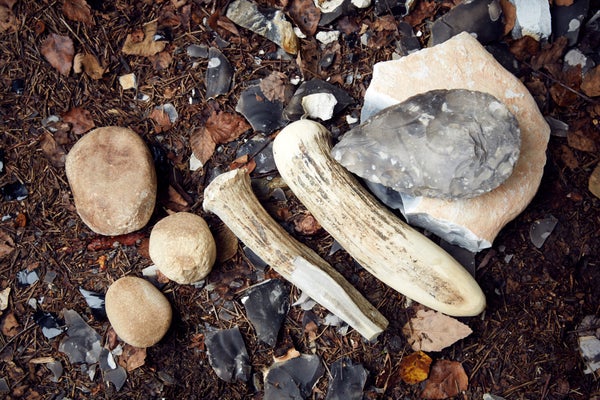
A flint hand-ax (Acheulean technology) made at Emory sits on a piece of flint, the raw material from which it was made. Different kinds of hammers used in production of the hand-ax are shown: stone hammers of varying size and hardness, and two antler billets (moose and elk), the latter used to strike “soft hammer” thinning flakes from the stone.
Gregory Miller
Join Our Community of Science Lovers!
On supporting science journalism
If you're enjoying this article, consider supporting our award-winning journalism by subscribing. By purchasing a subscription you are helping to ensure the future of impactful stories about the discoveries and ideas shaping our world today.
Reverse engineering ancient toolmaking practices provides a sort of time machine that takes scientists back to extract ideas about the cognitive abilities of our relatives from eons past. Researchers at Emory University teach students how to make two classes of stone age implements—Acheulean and Oldowan technologies—and observe what’s happening inside their skulls using brain scanners. The differences in scanner activity seen in the more advanced Acheulean technology may provide clues as to how brains evolved to become capable of fabricating more sophisticated tools. Anthropology professor Dietrich Stout discusses his work in experimental archeology in the April Scientific American.
It’s Time to Stand Up for Science
If you enjoyed this article, I’d like to ask for your support. Scientific American has served as an advocate for science and industry for 180 years, and right now may be the most critical moment in that two-century history.
I’ve been a Scientific American subscriber since I was 12 years old, and it helped shape the way I look at the world. SciAm always educates and delights me, and inspires a sense of awe for our vast, beautiful universe. I hope it does that for you, too.
If you subscribe to Scientific American, you help ensure that our coverage is centered on meaningful research and discovery; that we have the resources to report on the decisions that threaten labs across the U.S.; and that we support both budding and working scientists at a time when the value of science itself too often goes unrecognized.