
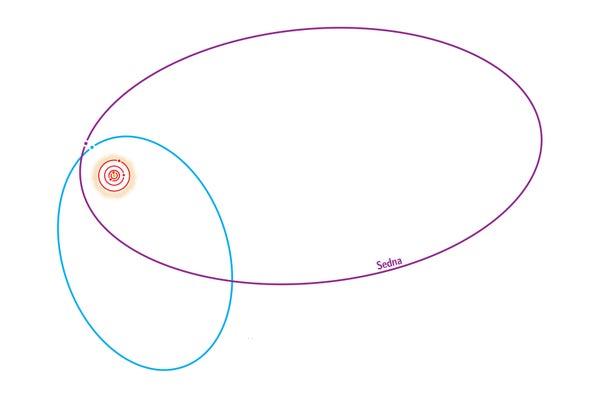
At the time of Sedna's discovery in 2003, it was the farthest body ever seen in our planetary club. Its peculiar path—it never ventures near the giant planets—suggested an equally peculiar history. How did it get there? The sun may have snatched Sedna away from another star, new computer simulations show.
A clue to Sedna's past came in 2012, when observers spotted a second and even smaller object with a similarly elongated and remote orbit. Astronomers Lucie Jílková and Simon Portegies Zwart of Leiden Observatory in the Netherlands and their colleagues decided to investigate whether interstellar robbery could produce the orbits of both Sedna and its sidekick, 2012 VP113. “We show that it's possible,” Jílková says. Moreover, the researchers reconstructed the crime scene and even the likely properties of the victim star, which they dubbed “Star Q.” In work submitted to Monthly Notices of the Royal Astronomical Society, the astronomers say Star Q was originally about 80 percent more massive than the sun. It passed within 34 billion kilometers of us—just 7.5 times greater than the distance from the sun to Neptune. This proximity means the star arose in the same stellar group or cluster as the sun. Although Star Q still exists, its fiercest light probably burned out long ago because of its greater mass. As a dim white dwarf, it will be hard to find.
The new work makes a “pretty convincing case” that Sedna could be captured, says astronomer Scott Kenyon of the Harvard-Smithsonian Center for Astrophysics. But Sedna discoverer Mike Brown of the California Institute of Technology contends that the object most likely is native to our solar system and got yanked outward by the gravitational tug of the sun's siblings—a simpler scenario.
On supporting science journalism
If you're enjoying this article, consider supporting our award-winning journalism by subscribing. By purchasing a subscription you are helping to ensure the future of impactful stories about the discoveries and ideas shaping our world today.
The issue may remain unresolved until more objects with odd orbits are found in the outer reaches of our solar system. “When we have something like a dozen, I think we'll probably know,” Brown says. If the sun stole these objects from Star Q, they should all come closest to Earth on the same side of the sun. But if their orbits differ, the sun probably is innocent of theft.