
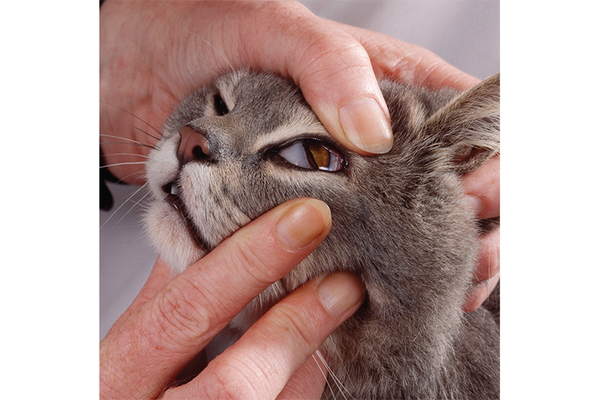
A cat has upper and lower eyelids that meet when the eye closes, along with a mysterious third eyelid—more properly called the palpebra tertia, also known as the nictitating membrane or “haw.” Tucked in the inner corner of the cat’s eye, the third eyelid is a biological curiosity long thought to be irrelevant, much like the human appendix or wisdom teeth. Veterinary articles written in the early 1900s even described methods for removing the extra eyelid to make it easier to examine the eye. But the third eyelid actually plays an important role in maintaining the eye’s health. In fact, most mammals and birds have a third eyelid—those lacking one, such as humans and some of our fellow primates, are the true oddities.
The anatomy of the third eyelid is complex. It is a fold of tissue covered by a double-sided mucous membrane, the conjunctiva, which faces the inner surface of the eyelid on one side (the palpebral surface) and the cornea on the other side (the bulbar surface). Embedded in the bulbar surface is a dense array of lymphoid follicles—tiny compartments containing disease-fighting cells—that are in contact with the surface of the eye and with a thin layer of liquid called the tear film. The follicles function as the lymph nodes of the eye.
Between the two layers of the conjunctiva is a dense, T-shaped cartilage plate. The crossbar of this T cartilage stiffens the free edge of the third eyelid and curves to hug the corneal surface. Surrounding the stem of the T cartilage is a gland that produces much of the water component of the tear film. The gland releases these watery tears through tiny ducts between the lymphoid follicles on the inner surface of the third eyelid, replenishing the tear film while allowing the immune system to gain access to the ocular surface.
On supporting science journalism
If you're enjoying this article, consider supporting our award-winning journalism by subscribing. By purchasing a subscription you are helping to ensure the future of impactful stories about the discoveries and ideas shaping our world today.
In cats, as in most mammals and birds, the third eyelid is large enough to completely cover the cornea and acts much like a windshield wiper—removing debris from the surface and redistributing tears over the cornea. When the cat is alert, the third eyelid is mostly hidden within the eye socket, with only a small portion visible in the inner corner of the eye. Yet when the cat is relaxed, during sleep or blinking, a set of skeletal muscles retracts the eyeball and allows the third eyelid to float across the ocular surface from the inner, lower corner of the eye to the upper, outer corner. Movement of the third eyelid in cats is also partially regulated by the sympathetic nervous system and by smooth muscle cells within the third eyelid.
The third eyelid’s function is not fully understood, but it is believed to help protect the cornea from physical injury, especially when the cat is capturing prey or moving through dense vegetation. It also allows cats to produce more tears than primates do, perhaps to better moisten the much larger cornea of the feline eye. The lymphoid follicles covering the surface of the third eyelid dump antibodies and other immunological mediators into the tear film, bathing the ocular surface and protecting it from the stew of bacteria and fungi that inhabit the surface of any eye.
The third eyelid not only serves as a windshield wiper of sorts but also can be an easy-to-read gauge of the cat’s overall well-being. When the membrane protrudes from its corner more than usual in both eyes, the expansion is often a sign of a generalized health problem or dehydration. Correct these problems, and the membrane returns to its normal position.
Experts also believe that the third eyelid helps to keep the surface of the eye moist, by holding the tear film against the cornea more tightly than the upper and lower eyelids alone. Loss of the third eyelid frequently results in chronic irritation of the cornea and the remaining conjunctiva.
So why don’t humans have a third eyelid instead of a rudimentary fleshy bump in the inner corner of the eye? Although the exact reason is unknown, it may be related to the fact that humans do not typically capture prey by biting (as cats do) or find food by rooting through vegetation (as horses do). Thus, there may be no advantage for us in having this extra measure of protection for the eye’s surface.