
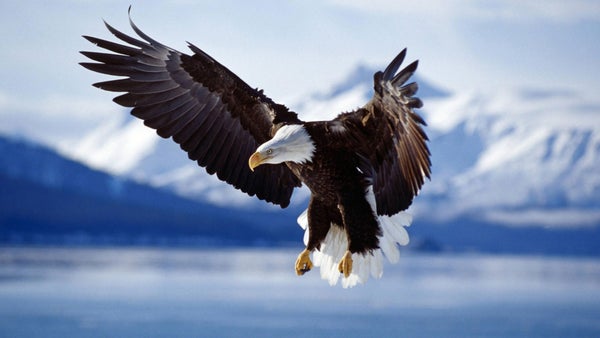
The newest additions to the Dutch National Police (DNP) are North American "immigrants": bald eagles that are specially trained to take down airborne drones.
The initiative is a first for law enforcement, according to DNP officials. They announced in a statement, released Sept. 13, that the DNP is currently the only police force in the world to include raptors on its roster for drone defense.
For the past year, the DNP has tested eagles' prowess against flying drones, collaborating with a private company called Guard from Above that trains raptors to snatch drones out of the sky. The tests were so successful, the DNP reported, that the police force recently purchased juvenile bald eagles that it plans to train. Agents will work with the eagles hand in glove—literally, because eagle talons are extremely sharp. [Send in the Eagles! Dutch Police Use Avians to Deter Drones | Video]
On supporting science journalism
If you're enjoying this article, consider supporting our award-winning journalism by subscribing. By purchasing a subscription you are helping to ensure the future of impactful stories about the discoveries and ideas shaping our world today.
The young eagle recruits have wingspans that currently measure about 3.3 feet (1 meter) long. When the eagles are fully grown, their wings could extend between 5.9 and 7.5 feet (1.8 and 2.3 m). The DNP expects that the eagles will be ready for action in about six months, according to the statement.
Michel Baeten, an operational manager for the DNP, told news agencyAgence France-Presse (AFP) that using birds of prey is one of several methods Dutch police employ to combat drones, alongside electromagnetic pulses and laser technology.
Baeten called eagles "one of the most effective countermeasures against hostile drones," the AFP reported.
So, what drones might be considered "hostile"? These aerial vehicles could be a threat, for instance, to visiting diplomats, as the DNP demonstrated Sept. 9 in a mock "attack." In the department's test setting—enacted on video—a man playing a VIP emerged from a motorcade at a public location. As he greeted people, a drone flew toward him, and it was quickly intercepted by a trained bird.
The eagle-eyed trainees are taught to see drones as prey and respond accordingly, officials said in the statement. Just as eagles capture prey and bring it to their nests, the trained eagles not only disable the drones but also relocate a safe distance from crowds.
Tough, scaly skin on eagles' feet protects them against bites from most of their usual prey, and likewise protects them from being harmed by small drones' propellers. Larger drones, however, might prove more damaging. The DNP reported that the Netherlands Organisation for Applied Scientific Research (TNO) will design a special "claw protector"—called klauwbeschermer, in Dutch—that it will use to keep the eagles from being injured in the line of duty.
Copyright 2016 LiveScience, a Purch company. All rights reserved. This material may not be published, broadcast, rewritten or redistributed.