
Touching Textures
Modern prostheses can provide amputees with a wide variety of motor functions, but they cannot give patients back their sense of touch. Until now, that is. In a collaborative effort, researchers at the Swiss Federal Institute of Technology in Lausanne and the Sant'Anna School of Advanced Studies in Pisa, Italy, developed a bionic fingertip that allowed an amputee to distinguish between smooth and rough textures with 96 percent accuracy. The fingertip is composed of an electrical sensor coated in a polymer, which translates surface coarseness into current pulses relayed to a nerve in the arm. The setup may even alleviate “phantom limb” pain, a common ordeal among amputees. Phantom hands are often perceived as being constantly clenched and painful, but the amputee in this experiment said he felt as though his phantom hand was feeling the surface, rather than remaining clenched. —Jessica Schmerler
A Realistic Replacement
On supporting science journalism
If you're enjoying this article, consider supporting our award-winning journalism by subscribing. By purchasing a subscription you are helping to ensure the future of impactful stories about the discoveries and ideas shaping our world today.
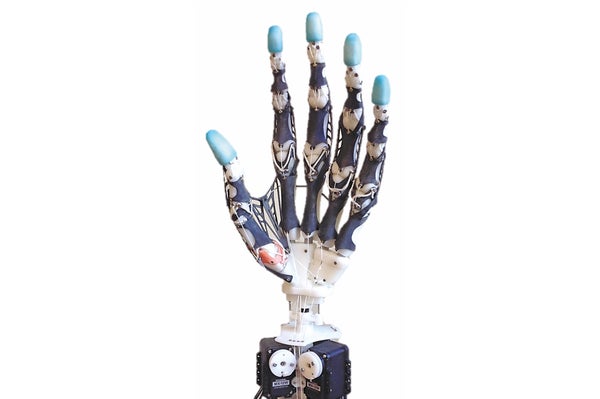
Advances in 3-D printing have allowed scientists to build complex biomimetic hands, with plastic bones and ligaments that mirror every point of articulation in a natural human hand (see image above). As laboratory-grown human tissues are becoming more robust and viable, researchers hope that one day such biomimetic hands will serve as scaffolds over which the organic tissue of a real hand can be grown. University of Washington researcher Emanuel Todorov, who developed the hand pictured here with Zhe Xu of Yale University, says that using 3-D-printed plastic parts minimizes the possibility of rejection—a common problem with hand transplants—while cutting costs to a fraction of those associated with similar articulated prostheses. Because such models would look and act just like human hands, they also stand to have an easier learning curve for users. Not only will they operate like normal hands, 3-D printing also means each one could be customized to its user. —Ian Chant
Freeing the Fingers
Earlier this year an amputee was able to move individual fingers on his prosthetic arm with a 64 percent success rate, a Johns Hopkins University team reported in the Journal of Neural Engineering. The accomplishment is a major improvement over past experiments, which had only succeeded in moving combinations of fingers. The patient's brain signals were decoded by an electrocorticographic (ECoG) implant that can cover a large area of the brain, taking in and translating information from many groups of neurons and providing more stable readings than have been achieved through other methods. Even better, the signals controlling the prosthesis are intuitive, letting the patient operate the prosthetic hand without long training sessions. —I.C.
A Better Connection
Today's prosthesis users have to rely on visual cues to know whether they are touching or gripping something with their artificial hands. Now an improved “nerve cuff” allows for the sensation of tactile pressure to be communicated directly to the median, ulnar and radial nerves in the arm at the site of amputation. In a recent study, researchers at Case Western Reserve University and the Louis Stokes Cleveland VA Medical Center challenged blindfolded users to determine whether a wood block had been placed in their prosthetic hand and to locate and remove a magnetic block from a metal table. The subjects were able to tell when they were holding a block nearly 100 percent of the time. They were also more dexterous, locating the block faster, dropping it less often and making more natural corrections than in tests without the improved nerve-cuff feedback. The final piece of good news: subjects reported that with the better connection, they felt more confident and the prosthesis felt more like a part of their own body. —I.C.
