
By Julie Steenhuysen
Over Wynwood, the Miami neighborhood where Zika gained a foothold in the continental United States, low flying planes have been spraying naled, a tightly controlled pesticide often used as a last resort. It appears to be working, killing at least 90 percent of the target mosquitoes.
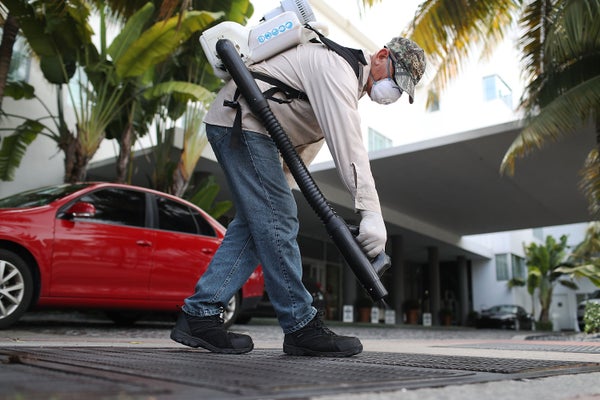
Across the Biscayne Bay in Miami Beach, wind and high-rise buildings make aerial spraying challenging. So, the effort in the popular tourist destination has focused on ground-sprayed pyrethroids - pesticides that are safer but don't always work.
On supporting science journalism
If you're enjoying this article, consider supporting our award-winning journalism by subscribing. By purchasing a subscription you are helping to ensure the future of impactful stories about the discoveries and ideas shaping our world today.
The arrival in Florida of Zika, a virus that can cause a crippling birth defect known as microcephaly, has drawn into focus the limitations of the U.S. mosquito control arsenal.
Larvicides reduce future populations relatively safely. But for use against the mature mosquitoes that spread disease, only two classes of pesticides are approved. Each has drawbacks.
Organophosphates, such as naled, are effective. But there are strict controls to limit risk. Pyrethroids are safer but have been used so much that mosquitoes, in many places, are immune.
"That's really the weak link in much of the United States," said Michael Doyle, director of the Florida Keys Mosquito Control District. "We're kind of caught off guard."
DENGUE PREVIEW
Doyle led a 2009 effort against a dengue outbreak in South Florida, the first in the United States in nearly a century. Authorities threw everything they had at the Aedes aegypti, the same mosquito that carries Zika: backpack fogging, door-to-door yard inspections looking for watery breeding sites and larvicide spraying.
Still, 88 people were infected before the virus was brought under control more than two years later, and there continue to be sporadic cases in Florida.
The outbreak highlighted gaps in the mosquito control arsenal that remain, according to pesticide makers, abatement officials and entomologists. Few companies make pesticides for use in public health outbreaks, a niche market that is expensive to get into, has a limited upside and varies season to season.
Safety testing a new pesticide can cost up to $250 million and take 10 years, said Karen Larson, vice president of regulatory affairs at privately held Clarke Mosquito.
As long as a product remains on the market, companies must continue testing for unforeseen side effects, an expense that some makers have blamed for decisions to abandon products.
"There's not a lot of profit," Larson said.
Sales of the Dibrome brand of naled have been estimated at $12 million a year. By comparison, total crop pesticide sales for some companies can exceed $500 million in a single quarter.
Bayer, Dow Chemical, BASF and other agricultural pesticide makers "are not interested in going after a $20 million or $30 million a year market," said William A. Kuser, investor relations director at Dibrome maker American Vanguard Corp.
The U.S. Environmental Protection Agency has approved several new pesticides in recent years. But it has received few requests for using them against mosquitoes, said Jim Jones, Assistant Administrator for the agency's Office of Chemical Safety and Pollution Prevention.
"Although it's of critical importance, the amount one can sell is small and it's variable, which makes it difficult for business planning," Jones said. "You can go many years without having much of a market at all, then suddenly, whether it's because of a nuisance outbreak of mosquitoes or something like West Nile or Zika, the market grows significantly."
Abatement authorities have pressed for help with the cost of developing mosquito control pesticides. The 1996 U.S. Food Quality Protection Act includes a provision for subsidies to defray the expense of safety testing, but Congress has never funded it.
RISK AND RESISTANCE
At least 49 cases of locally transmitted Zika infections have been reported in Florida, most in Wynwood and Miami Beach. Most people have no symptoms or mild illness.
Because of the microcephaly link, efforts are focused on preventing infection among pregnant women.
In Wynwood, the campaign began with pyrethroids, synthetic versions of a chemical derived from chrysanthemums. Amid signs of resistance, authorities switched to naled.
Developed as nerve agents, organophosphates, at high doses, can cause nausea, convulsions and death. They can be toxic to wildlife, including bees. The EPA considers naled safe at permitted ultra-low concentrations, and it is sprayed annually over 16 million acres in the United States.
But it is banned in Europe, where the risk is seen as unacceptable. In the U.S. territory of Puerto Rico, where Zika is widespread, the governor prohibited naled amid protests over safety concerns.
Although naled killed more than 90 percent of mosquitoes in traps set in Wynwood, the Aedes aegypti's resilience remains a concern.
"This is truly the cockroach of mosquitoes," said Tom Frieden, director of the U.S. Centers for Disease Control and Prevention.
DROPPING PESTICIDES
CDC entomologist Janet McAllister said pyrethroid resistance typically is limited by the mosquito's small range. When resistance to one pyrethroid develops, another often works.
Still, she said, "we would love to see additional classes of insecticides available because, even in places that may have an effective tool today, that doesn't mean it is going to last down the road."
The EPA can fast-track its evaluation of new pesticides and expand the use of old ones. In response to Zika, it expedited new uses for pesticide-treated bed nets and mosquito traps.
Still, development of pesticides is painstaking. Even if the EPA speeds up its evaluation, required safety data can take years to collect. And the expense of ongoing safety testing has prompted companies to drop products.
Bayer CropScience, for example, told distributors it dropped the pyrethroid resmethrin in 2012, rather than do additional testing. Clarke Mosquito gave up temephos, a larvicide, six years ago, because of costs, Larson said.
That decision led to stockpiling in southwest Florida, said Wayne Gale, director of the Lee County Mosquito Control District.
"We purchased just about every bit," he said.