
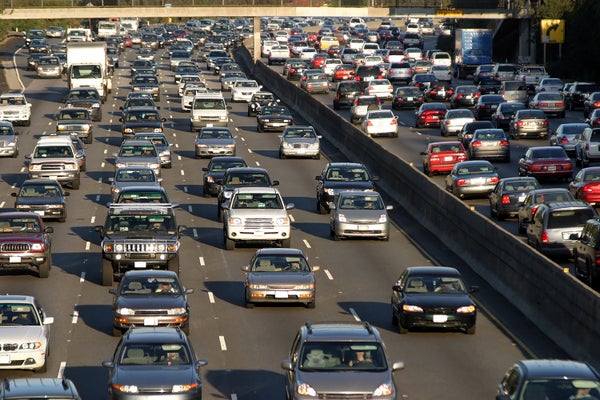
The Federal Highway Administration is considering measuring the success of state and local transportation projects by their greenhouse gas emissions.
FHWA asked for feedback on establishing the climate metric in a proposed rule establishing new performance standards for transportation projects receiving federal dollars. If finalized, it would be the first-ever requirement for all state and local transportation officials to tally and report their carbon pollution.
"It's a bold move by the secretary to include carbon pollution in the rule and it's also eminently reasonable," said Deron Lovaas, senior policy adviser on energy efficiency and transportation at the Natural Resources Defense Council. "Expecting planners to think about air quality and health goes to the heart of what it means to plan, so this is a promising first step."
On supporting science journalism
If you're enjoying this article, consider supporting our award-winning journalism by subscribing. By purchasing a subscription you are helping to ensure the future of impactful stories about the discoveries and ideas shaping our world today.
The 423-page document includes six pages on greenhouse gas emissions, and even there, the idea is floated rather than concrete. FHWA asked a series of questions to determine whether or not it should include a carbon dioxide measure in the final rule, expected at the end of the year. The agency said the unit for the metric would probably be annual tons of CO2 from on-road mobile sources, but it didn't say whether upstream emissions from vehicle manufacturing or construction and maintenance emissions would be covered.
Transportation accounts for 26 percent of the country's greenhouse gas emissions. On-road vehicles, both light-duty and heavy-duty, contribute more than 80 percent of that share.
Several states and cities already account for greenhouse gas emissions in their transportation planning. FHWA has previously developed some tools, including a handbook and a model, to encourage more state departments of transportation and metropolitan planning organizations to do the same. But "FHWA recognizes that more will be needed to meet the U.S. climate goals," including international commitments to cut emissions, according to the proposal.
The proposed rule fulfills a requirement of the 2012 Moving Ahead for Progress in the 21st Century Act (MAP-21), which sought to create new ways to measure the success of transportation projects. Carbon pollution would join other metrics proposed by FHWA, like congestion, freight movement improvement, pavement condition, and fatalities and injuries.
"What's attractive here is they're kind of taking transportation out of its box and connecting it to other goals and measures," said Robert Puentes, director of the Eno Center for Transportation. "Everybody says transportation is a means to an end; well, here is the end, whether it's connecting people to economic opportunity or cleaning the environment."
Having the carbon emissions measure in place could spur vehicle electrification and development of rail and bus rapid transit. Other things that could be affected are road pricing to decrease congestion or housing development decisions, said Lovaas.
Questions on legal authority
The notice of proposed rulemaking is the third in a series establishing performance measures. It will be officially published in the Federal Register on Friday. A 90-day comment period will follow.
Some critics questioned whether MAP-21 requires the agency to include carbon pollution in the new performance standards at all. The law sets lowering fuel consumption and reducing air pollution as national objectives but stays clear of mentioning greenhouse gas emissions.
"This is outside of the scope of what Congress agreed to," said Nick Goldstein, vice president of environmental and regulatory affairs for the American Road and Transportation Builders Association. "If it's truly something they want to do, let's do it separately, and let's find bipartisan support."
He also suggested that more standards could slow much-needed infrastructure improvements.
Emil Frankel, who formerly held senior roles in the federal and Connecticut transportation departments and is now a senior fellow at the Eno Center for Transportation, predicted that the climate metric would face a long legal fight.
"It's something that I have favored, but I think it will be controversial," he said.
Environmental advocates said the Department of Transportation has the authority to set standards for greenhouse gases because they are air pollutants.
FHWA decided to add a potential greenhouse gas emissions measure to the rule after receiving comments from several advocacy groups, local governments, a couple of states and members of Congress, according to the agency.
Sixteen House Democrats urged Transportation Secretary Anthony Foxx to include an explicit greenhouse gas emissions metric in the new performance measures in a letter in February. The National Association of City Transportation Officials, representing 41 cities from Los Angeles to Seattle to New York, also recommended the standard, saying "it would be more effective than the approach currently in place" to promote sustainable transportation.
Brian Kelly, secretary of the California State Transportation Agency, wrote to Foxx in January in support of the measure. The state and its 18 MPOs have been tracking and reporting greenhouse gas emissions from transportation since the passage of S.B. 375 in 2008.
Other letters and results from listening sessions held by the agency will be added to the docket Friday.
Reprinted from Climatewire with permission from Environment & Energy Publishing, LLC. www.eenews.net, 202-628-6500