
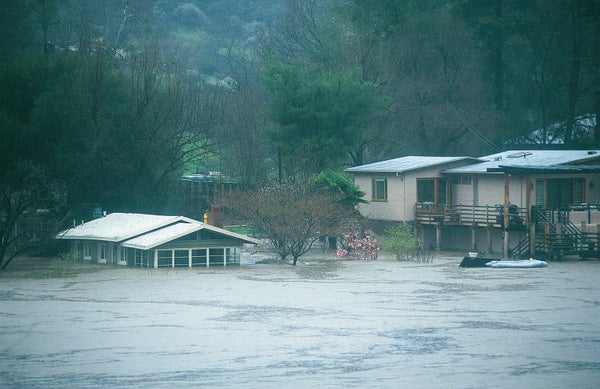
Disaster-struck communities tend to rebuild from floods and violent storms using decisionmaking tools that rely too much on past data, the head of the Federal Emergency Management Agency said yesterday.
But that won't be helpful with sea-level rise and other unpredictable climate change-related risks of the future.
"The lesson we keep learning is that past data is not keeping up with changing environmental trends, population densities, technology," said FEMA Administrator Craig Fugate during a gathering at the National Academy of Sciences focused on resilience.
On supporting science journalism
If you're enjoying this article, consider supporting our award-winning journalism by subscribing. By purchasing a subscription you are helping to ensure the future of impactful stories about the discoveries and ideas shaping our world today.
"Can we build back to what the past data says? If you look at sea-level rise ... how do you build for future risk when in many cases you have inadequate past data, and it's not taking into account future risk and future trends?" he asked.
A lack of reliable planning information to address climate change is a common complaint among municipal and state leaders, who say they want more information about how to better weave adaptation into their planning. They include utility managers who want more information about how to handle runoff from intense rainfall fueled by global temperature increases, reservoir managers trying to adjust to drought conditions, and ski resorts assessing snowpack and other climate-related changes.
Fugate said using a cost-benefit analysis approach based on past trends won't be effective as local governments, businesses and insurers figuring out more resilient ways to plan for the effects of climate change.
There's often intense local pressure to rebuild communities as they were, he said, even if the future risk from sea-level rise or other climate risks suggests it's not the most prudent path.
But post-disaster is also a really good time to think about creating more resilient communities that factor in climate change and other stressors and plan for a time when flood insurance might not be as heavily subsidized.
Municipal leaders becoming 'weather savvy'
Many communities have, by necessity, begun to be more climate-resilient, said Michael Seibert, the mayor of Joplin, Mo., where 158 people died in a 2011 tornado, the costliest such storm in U.S. history.
There, the city had to think about how to revise its planning codes to make homes safer and whether to mandate storm shelters in homes, a move it decided not to take.
"We'll have winters where we have little snow; we'll have winters where we have a lot of snow and ice storms. We'll have summers with violent storms; we'll have summers with floods," Seibert said. "In an atmosphere like that, literally and figuratively, we tend to be more weather alert and weather savvy. We're always attuned to those challenges, and it's just really a part of who we really are, at least in our part of the country. It truly is part of us."
It's the same in Utah, where they plan not only for earthquakes but for climate change-fueled wildfires and flooding, said Salt Lake County Mayor Ben McAdams. The drinking water for 500,000 people in the region comes from mountain snowmelt, McAdams said, and rainfall patterns are changing. Snow is also melting faster than the region's systems are able to capture it.
"Climate change will have an effect on us," McAdams said. "We'll see greater risk because of climate change in both wildfires and flooding, and we're concerned. Are our flood control systems capable of handling the changes we'll see in the future? What does this mean for our communities?"
Superstorm Sandy led the Army Corps of Engineers to wholeheartedly embrace the concept of resilience, said Lt. Gen. Thomas Bostick, the chief of the Army Corps, who is retiring this week. Sandy, which hit the East Coast in the first six months of his tenure, forced him to confront some of the social vulnerabilities of managing people as sea levels rise. People didn't want to leave their homes because they were afraid their belongings would be stolen when they evacuated, he said.
"It's structural, it's nonstructural, it's what you do in terms of communications ... how you manage a storm or disaster," he said. "There's an information component to it, and I think there's a social piece."
NOAA, FEMA issue resilience report
Resilience is usually defined as a community's ability to adapt to changing conditions, to withstand disruptions from natural and man-made disasters, and to recover quickly from emergencies.
Yesterday's event, which looked at the state of resilience in the United States, came the same day as FEMA and the National Oceanic and Atmospheric Administration issued a draft report outlining 32 indicators that measure a community's resilience. The indicators are intended to help local governments, businesses and federal agencies describe and assess what's known as community resilience capacity.
Knowing what capacity a community has to respond to disasters or other stresses can help with planning and budgeting for everything from wildfire response to heat waves and droughts—or even a housing crisis caused by flooding. It can also help governments budget for disasters, or soften their blow with skillful planning. The report calls community resilience to hazards, including the impacts associated with climate change "an element of overall national security."
The agencies are proposing measures that assess such factors as a community's housing capacity, its ability to provide health and social services, how it might be able to recover from an economic downturn, the status of its infrastructure and its natural and cultural resources, what hazards it faces in the future, and what it has done to plan for them or reduce vulnerabilities.
Reprinted from Climatewire with permission from Environment & Energy Publishing, LLC. www.eenews.net, 202-628-6500