
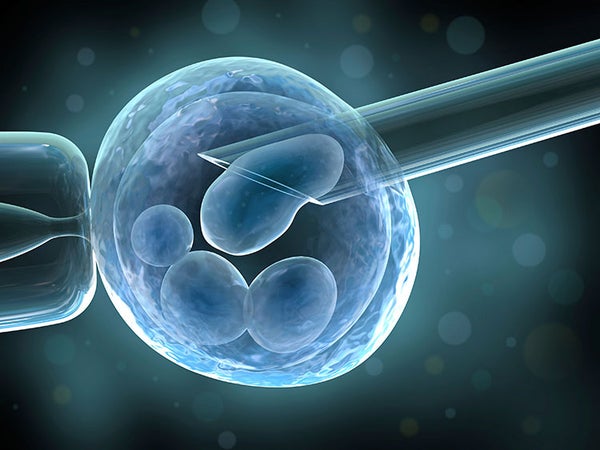
The U.S. Food and Drug Administration (FDA) should approve clinical trials to transfer DNA from healthy human eggs to diseased embryos, the US National Academy of Medicine said today.
The controversial gene-therapy technique involves replacing an embryo’s energy-producing mitochondria with healthy mitochondria from the egg of a second woman. The aim is to prevent the transmission of diseases caused by mutations in mitochondrial DNA. But concerns about the safety of mitochondrial replacement, and the psychological and social implications of children with three genetic parents, have given U.S. regulators pause.
In its report, the academy panel suggests limiting the tests of the technique to male embryos as a safety precaution. Male offspring would not be able to pass their modified mitochondria to future generations, because a child inherits its mitochondria from its mother.
On supporting science journalism
If you're enjoying this article, consider supporting our award-winning journalism by subscribing. By purchasing a subscription you are helping to ensure the future of impactful stories about the discoveries and ideas shaping our world today.
The report also outlines several additional steps to monitor the safety of mitochondrial replacement. These include following the children created by the technique for years and sharing the resulting data on their health.
If mitochondrial replacement is proven safe in male offspring, it could be expanded to female embryos, the advisory panel said.
The approach stands in contrast to that of the United Kingdom, which last year approved mitochondrial replacement with no restrictions on the sex of a modified embryo.
Barriers to research remain
For Shoukhrat Mitalopov, a reproductive-biology specialist at the Oregon Health Sciences University in Portland, the advisory panel’s recommendation is a hollow victory. The FDA commissioned the $1.1 million National Academy of Medicine review in 2014 after Mitalipov applied to perform a clinical trial of mitochondrial replacement therapy with human embryos. But the fiscal year 2016 government spending bill enacted last month includes language preventing the FDA from approving any applications to implant modified human embryos into women.
“It’s good news, but the future seems very hazy compared to a few months ago,” Mitalipov says, given the restrictions included in the spending bill. Still, his lab is beginning to breed monkeys treated with mitochondrial replacement, in hopes of understanding how this genetic modification could affect subsequent generations of offspring.
Others disagree with the National Academy of Medicine panel’s conclusions. The new report “realized all the concerns and leapt to the conclusion that things should go forward despite all the concerns,” says Marcy Darnovsky, president of the non-profit Center for Genetics and Society in Berkeley, California, who has opposed mitochondrial replacement in humans on both safety and ethical grounds.
Darnovsky says that she would like to see an international agreement and legislation to ban techniques that edit embryos’ nuclear genomes. “I would have more faith in the argument if allowing this technology isn’t going to pave the way for more concerning forms of germline editing,” she says.
Read More: U.S. Congress Moves to Block Human Embryo Editing Controversial Gene-Editing Approach Gains Ground When Will “3-Parent Babies” Come to the U.S.? Making Babies with 3 Genetic Parents Gets FDA Hearing
This article is reproduced with permission and was first published on February 3, 2016.