
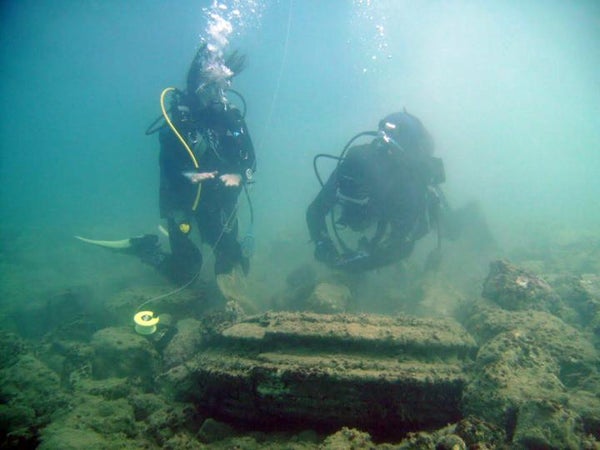
When divers off the Greek island of Zakynthos chanced upon an underwater labyrinth of stone several years ago, they encountered eerie scenes reminiscent of cobblestone floors and the bases of Hellenic-like colonnades, conjuring images of a city that had vanished beneath the waves thousands of years in the past. But when Greek authorities took a closer look they found no nearby signs of human life such as pottery shards, coins or tools. And now new research indicates that the structures are not human-made at all, rather they are natural formations sculpted by the breakdown of methane gas within the ocean floor—millions of years before civilization.
University of East Anglia environmental sciences professor Julian Andrews and his colleagues conducted laboratory studies of the chemical makeup of samples from the underwater labyrinth. Their analysis, published this week in Marine and Petroleum Geology, revealed that the structures are likely a result of their location: directly above a subsurface fault still hidden by the seabed, where methane oozes out of Earth’s crust in various ways. Microbes in the sediment use carbon in the methane as a fuel, which alters the chemistry of the sediment and forms a natural cement. Over time currents erode softer surrounding sediment, revealing the harder, naturally formed structures.

The ancient underwater remains of a long lost Greek city were in fact created by a naturally occurring phenomenon—according to joint research from the University of East Anglia and the University of Athens (Greece). Credit: University of Athens via EurekAlert
On supporting science journalism
If you're enjoying this article, consider supporting our award-winning journalism by subscribing. By purchasing a subscription you are helping to ensure the future of impactful stories about the discoveries and ideas shaping our world today.
Researchers say the formations’ different shapes are likely the result of the various types and sizes of the methane leaks. For example, the colonnadelike structures could have been formed when methane jets shot up through the sediment and interacted with bacteria clustered tightly around the jets. “It’s kind of like a frozen plumbing system,” Andrews says. The floorlike structures, on the other hand, were probably formed when methane seeped toward the surface in a slow and diffuse manner, before interacting with a horizontal layer of bacteria within the sediment. “So rather than it forming a very discrete structure around the pipe, it's actually producing a flat structure,” he says.
This process, known as concretion, is quite common but usually occurs in the ocean depths. It is rare to find examples in shallower waters such as bays and river deltas. And when divers do so, it is easy for them to mistake the formations for human-made structures.

Credit: University of Athens via EurekAlert
Other types of underwater structures have triggered more debate. Off the southern Japanese island of Yonaguni divers and researchers have long been amazed by geometric stone structures that many say resemble an arch, a number of temples, a stadium, a pyramid and parts of a castle. But the site’s origin remains a subject of scientific controversy. And many experts say it could easily be the result of natural processes—such as the tendency of sandstone to break along planes, creating clean and symmetric edges that can appear human-made.
As Andrews and his colleagues summarize in their research paper: “‘All that glistens is not gold’—or in this case ‘columns and pavements in the sea, not always antiquities will be.’”