
Brazilian folk tradition holds that if your asthma is acting up, you might consider sharing dinner with a bird.
Feeding leftovers to a white-naped jay in particular is thought by some healers to transfer the illness to unsuspecting avians. If that doesn’t work, the roasted, powdered liver of the black vulture also apparently helps open restricted airways.
Birds and certain bird bits — their beaks, their feathers, their livers — are involved in traditional remedies throughout the world, practices that trace back to Mesopotamia, Ancient Egypt and early China. It turns out birds may play a helpful role in modern western medicine too. A new study suggests that the common pigeon can reliably distinguish between benign versus malignant tumors and, in doing so, could help researchers develop better cancer screening technologies.
On supporting science journalism
If you're enjoying this article, consider supporting our award-winning journalism by subscribing. By purchasing a subscription you are helping to ensure the future of impactful stories about the discoveries and ideas shaping our world today.
Diagnosing cancer has a lot to do with vision. Pathologists study biopsy samples looking for cancerous cells. Radiologists scan x-rays and MRIs for possible malignancies. The authors of the new study were curious how these specialists acquire the skill to identify features and qualities of an image that signify cancer. To find out they turned to pigeons. Though primates and pigeons haven't shared a common ancestor for over 300 million years (it looked something like this) our visual processing biology is surprisingly similar to that of birds.

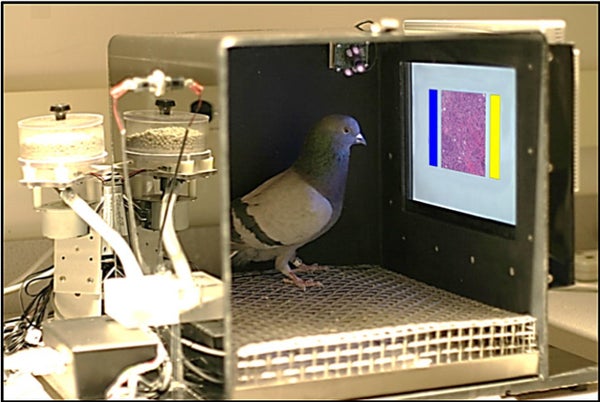
In the study, 16 pigeons were trained to detect cancer by putting them in a roomy chamber where magnified biopsies of possible breast cancers were displayed. Correctly identifying a growth as benign or malignant by pecking one of two answer buttons on a touchscreen earned them a tasty 45 milligram pigeon pellet. Once trained, the pigeons’ average diagnostic accuracy reached an impressive 85 percent. But when a “flock sourcing” approach was taken, in which the most common answer among all subjects was used, group accuracy climbed to a staggering 99 percent, or what would be expected from a pathologist. The pigeons were also able to apply their knowledge to novel images, showing the findings weren’t simply a result of rote memorization.
Credit: Univ. Iowa/Wassermann Lab
Analyzing mammograms proved more difficult for the birds, though they still proved themselves proficient radiologists. Even when presented with new images, they identified tiny accumulations of calcium that often indicate breast cancer with similar accuracy to the pathology images. However, though they could memorize suspicious tissue densities that can signal cancer, they were stumped when doing so on previously unseen mammograms.
“The birds might be able to assess the quality of new imaging techniques or methods of processing and displaying images without forcing humans to spend hours or days doing detailed comparisons to figure out if certain innovations are in fact better or worse than current methods,” said study co-author Dr. Richard M. Levenson, a professor in the Department of Pathology at the University of California Davis. Doing so would avoid the need to recruit and pay clinicians for these mundane, repetitive tasks.
Dr. Levenson cautions against expecting pigeon physicians any time soon: “I don’t anticipate that pigeons, no matter how good they become at pathology or radiology, will be playing a role in actual patient care—certainly for the foreseeable future. There are just too many regulatory barriers—at least in the West.” But he does believe the findings could help develop more effective training methods for budding clinicians.
Pigeon vision isn't as sharp as that of majestic raptors like eagles, hawks and falcons — birds of prey can spot the scurry of a field mouse from 1000 feet. But they’re easy to house and at least 50 years of research has confirmed that despite their commonplace reputation — puttering scavengers in search of a mishandled bagel — pigeons have plenty going on in their tiny bird brains, visually anyway. As the authors point out, pigeons can learn to recognize letters of the alphabet; identify objects like cats, cars and chairs; and distinguish between Monet and Picasso paintings. In all they can learn and remember nearly 2,000 images and even pick up on facial expressions indicating human emotions.
Levenson speculates that pigeons could contribute to technical image analysis in various fields, gauging qualities like brightness, contrast and compression. “Maybe the pigeons could determine if doing x,y, or z to an image makes it easier or harder to see a target of interest,” he commented, suggesting that beyond just practicing medicine the birds could assist with various remote surveillance operations, military and otherwise. Unlike, say, cancer-sniffing dogs, pigeons may not be ready for the clinic, but one could envision numerous ways to exploit their image-analysis talents.
Perhaps, given their eye for Impressionism, they might even find work in art restoration.