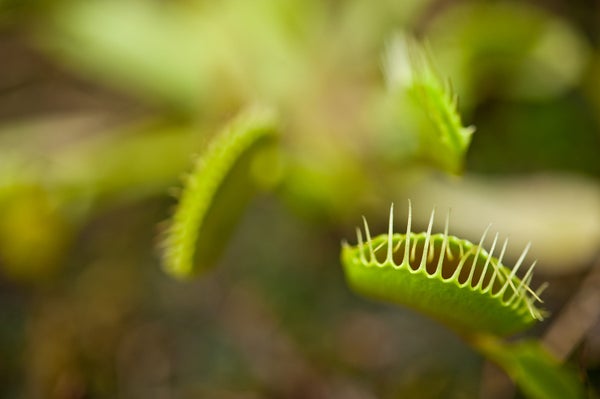
Venus Flytrap Inspires New Material That Snaps Back into Shape

Like the plant, a three-layered hydrogel can change shape then quickly return to original position

venus flytrap

Inspired by carnivorous plant’s movement, researchers have been designing polymers that rapidly change shape in response to external stimuli.

Join Our Community of Science Lovers!

Scientists in China have designed a smart material that rapidly switches from one shape to anotherjust like a Venus flytrap plant snaps close when trapping prey.

Inspired by carnivorous plant’s movement, researchers have been designing polymers that rapidly change shape in response to external stimuli. However, the snapping process is usually irreversible, which has so far limited the materials’ practical potential.

Courtesy of ChemistryWorld


On supporting science journalism

If you're enjoying this article, consider supporting our award-winning journalism by subscribing. By purchasing a subscription you are helping to ensure the future of impactful stories about the discoveries and ideas shaping our world today.


Tao Xie and co-workers from Zhejiang University have now created a hydrogel-based system that is the first to undergo reversible snapping. The assembly comprises layers of three dissimilar hydrogels: a non-responsive, a thermo-responsive and a pH-responsive one, which are held together with a supramolecular glue. This allows the material to react to pH or temperature changes and switch between two shapes (eg convex and concave disk).

Xie and co-workers suggest that the rapid snapping mechanism could be extended to other shape-changing materials, such as shape memory polymers and liquid crystalline elastomers.

This article is reproduced with permission from Chemistry World. The article was first published on July 28, 2016.

It’s Time to Stand Up for Science

If you enjoyed this article, I’d like to ask for your support. Scientific American has served as an advocate for science and industry for 180 years, and right now may be the most critical moment in that two-century history.

I’ve been a Scientific American subscriber since I was 12 years old, and it helped shape the way I look at the world. SciAm always educates and delights me, and inspires a sense of awe for our vast, beautiful universe. I hope it does that for you, too.

If you subscribe to Scientific American, you help ensure that our coverage is centered on meaningful research and discovery; that we have the resources to report on the decisions that threaten labs across the U.S.; and that we support both budding and working scientists at a time when the value of science itself too often goes unrecognized.

In return, you get essential news, captivating podcasts, brilliant infographics, can't-miss newsletters, must-watch videos, challenging games, and the science world's best writing and reporting. You can even gift someone a subscription.

There has never been a more important time for us to stand up and show why science matters. I hope you’ll support us in that mission.

Thank you,

David M. Ewalt, Editor in Chief, Scientific American

Subscribe