
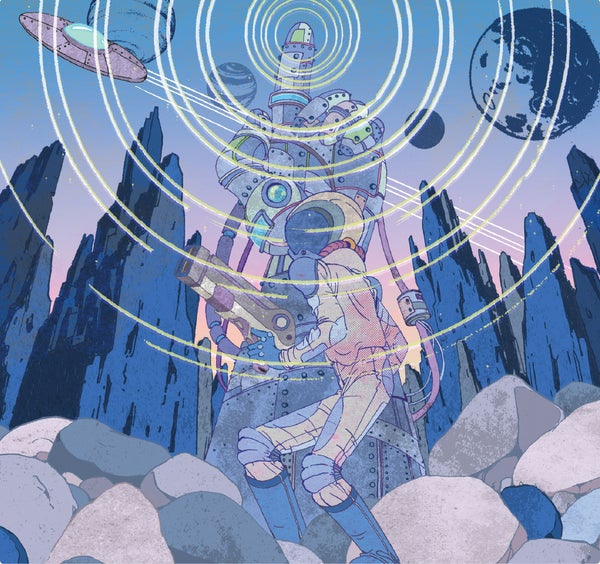
Quarantine Zone
by Daniel H. Wilson. Illustrated by Fernando Pasarin
DC Comics, 2016 ($22.99)
The capacity for violence is an illness with a cure in this graphic novel. Society restricts the few “incurables” to a lawless region called the Quarantine Zone, patrolled by enforcers who keep the incurables out and the disease contained. When an enforcer is exposed to the virus that allows aggression, he ends up on the run in the zone and discovers that having an ability for evil does not necessarily mean people will choose to act on it. Quarantine Zone is a beautifully illustrated, fast-paced look into a future where society must decide if “curing” human behavior can ever be justified. —Jennifer Hackett
Too Like the Lightning
by Ada Palmer. Tor Books, 2016 ($26.99)
On supporting science journalism
If you're enjoying this article, consider supporting our award-winning journalism by subscribing. By purchasing a subscription you are helping to ensure the future of impactful stories about the discoveries and ideas shaping our world today.
It is 2454, and technology has enabled a semi-Utopian society to form: geographical nations have been replaced by ideological “hives” that unite the like-minded, religion is banned because of its tendency to incite conflict and even acknowledging a person's gender is considered offensive. The rules seem to ensure harmony and prosperity, but below the surface political tensions simmer. Against this backdrop, a convicted criminal, bound to travel the world serving others to atone for his deeds, gets caught up in a global power struggle as factions and fortunes shift in the wake of a mysterious theft. This imaginative tale ponders whether any human society can sustain peace over the long term.
Join
by Steve Toutonghi. Soho Press, 2016 ($27)
In a near-future society, digital networks link individuals' brains to make “joins”: collective minds controlling multiple bodies called drives. As Chance, a join of five, and Leap, a join of four, try to understand a puzzling illness affecting joins, they learn unsettling truths about the miracle technology that created them and come to question whether people can be both individuals and collectives without losing something in the process. —J.H.
Sleeping Giants
by Sylvain Neuvel. Del Rey, 2016 ($26)
A giant metal hand discovered in present-day South Dakota defies scientific explanation. Carbon dating suggests it is ancient, yet its construction is beyond the capabilities of modern technology. Soon more body parts show up, and a physicist, a linguist, a geneticist and two military pilots team up to crack the puzzle: Is the discovery a futuristic tool for learning about the universe or a massively destructive weapon? This page-turner probes the intellectual and political fallout of an astonishing find.
Dark Matter
by Blake Crouch. Crown, 2016 ($26.99)
This quantum-mechanics-inspired thriller follows physicist Jason Dessen, who suddenly finds himself in an alternative universe where his life has played out very differently. Instead of living an unremarkable existence with his wife and son, the Dessen in this new reality has devoted himself to his career and achieved world-changing breakthroughs. As he faces the future in his parallel life, Dessen yearns for his lost family and struggles with the repercussions of glimpsing the road not taken.
