
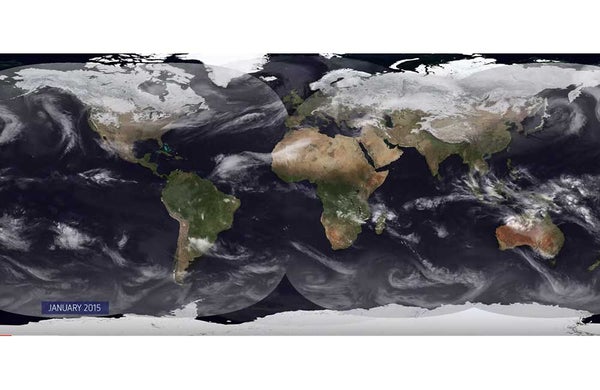
Another year of wild weather is behind us. But thanks to EUMETSAT, you can now relive it in amazing high-definition video from space.
The new visualization uses geostationary satellite data from EUMETSAT, the Japan Meteorological Agency and the National Oceanic and Atmospheric Administration to stitch together 365 days of data into one stunning highlight reel of 2015’s weather.
And what a year it was. You’ll definitely want to keep your eye on the tropics throughout the animation as the northern hemisphere set a record for the most major tropical cyclones to form in a year.
On supporting science journalism
If you're enjoying this article, consider supporting our award-winning journalism by subscribing. By purchasing a subscription you are helping to ensure the future of impactful stories about the discoveries and ideas shaping our world today.
Around the 6:30 mark, you can see the evolution of Hurricane Joaquin, the strongest Atlantic hurricane of 2015. It went from a tropical depression in late September to a Category 4 storm that battered the Bahamas and menaced the East Coast before steering all the way across the Atlantic and plowing into the U.K.
Hurricane Patricia became the strongest hurricane ever recorded in October and at the 6:55 mark, you can see it quickly slam into Mexico’s west coast before heading inland to inundate parts of Texas.
But beyond the highlights, there’s also yearly the ebb and flow of weather on our fair planet. During the southern Amazon’s rainy season, which last from December-April, you can see clouds pop up almost daily to spread rains across the region. Clouds become far less plentiful during the region’s dry season.
And more broadly, you can see weather patterns flow across continents and oceans. Today’s storm in the Southeast U.S. is next week’s rain in Spain. By putting together a global view of our planet, EUMETSAT’s video shows how our atmosphere is the common tie that binds humanity together.
There have been a few things updated since last year’s version. For one, EUMETSAT has cranked the resolution to 4K for truly epic detail. And more importantly, the quality of satellites in space has improved.
Both Japan and EUMETSAT launched new satellites last year that have higher resolutions than their predecessors. The National Oceanic and Atmospheric Administration plans to launch a new high resolution geostationary satellite this year, adding even more detailed coverage of the planet.
That’s good news if you want an even sharper 4K experience or improved forecasts. And if you want both, well, then life is really good.
This article is reproduced with permission from Climate Central. The article was first published on February 1, 2016.
