
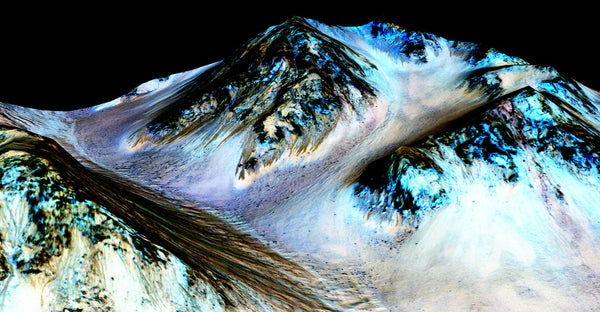
The Red Planet is wet, scientists announced today. New evidence from NASA’s Mars Reconnaissance Orbiter (MRO) confirms that suspicious dark streaks on Mars that appear and disappear with the seasons are created by flowing liquid water. The streaks are made by salty water that runs down steep hills during warm months, when temperatures are above –23 degrees Celsius, and freezes during colder times.
The intriguing streaks, called recurring slope lineae, were first spotted in 2010 in images from the MRO’s HiRISE (High-Resolution Imaging Science Experiment) camera. Scientists have long suspected that the streaks marked the location of liquid water. Now researchers have found the chemical signatures of hydrated minerals on these slopes, confirming that explanation. The new evidence also comes from the MRO via CRISM, its Compact Reconnaissance Imaging Spectrometer for Mars, which separates light into its constituent wavelengths to reveal the chemicals present on the Martian surface. The instrument saw the signatures of magnesium perchlorate, magnesium chlorate and sodium perchlorate—all hydrated salts that require water to form and also contain it. The chemicals appear in the summer, when the dark streaks are visible, and disappear along with the features when temperatures drop. “This is the best evidence of liquid water on Mars in the present day,” says Georgia Institute of Technology scientist James Wray, co-author of a paper reporting the data published today in Nature Geoscience. “The fact that these chemicals are sitting on these flows and concentrated there and have water means there’s really no way that water wasn’t involved.” (Scientific American is part of Nature Publishing Group.)
On supporting science journalism
If you're enjoying this article, consider supporting our award-winning journalism by subscribing. By purchasing a subscription you are helping to ensure the future of impactful stories about the discoveries and ideas shaping our world today.
The findings provide yet more evidence that Mars is not a dry and barren landscape but rather a dynamic place that changes with the seasons—and, just maybe, holds the ingredients necessary for life. Primary among those ingredients, of course, is water, which makes the recurring slope lineae a prime spot to search for signs of extraterrestrial microbes.

Click to enlarge. Illustration by Chuck Carter. Originally produced for "Mars in Motion," by Alfred S. McEwen, in ScientificAmerican, May 2013
Wray says the new evidence for water is an encouraging development in the search for life, but he points out that there is much we still don’t know—“how deep the water goes, how low the temperature gets and how high the salt concentration gets. We need to characterize those aspects of the water to really be able to answer the question [of habitability]. But at least we know where to look now.”
The recurring slope lineae, most of which are roughly a few meters wide and tens to hundreds of meters long, are common throughout the planet’s equator and mid-latitudes. “These features are very sensitive to temperature,” Alfred McEwen, principal investigator for the HiRISE camera at the University of Arizona in Tucson, said Monday during a NASA press conference announcing the results. “They form at different times and different latitudes on Mars, all related to the seasonal variations at those locations. The darkening can be explained if these are seeps of water that seep through the shallow surface layer and darken the surface layer.” The hydrated minerals indicate the water there is briny and the salts allow it to stay liquid in colder temperatures than would otherwise be possible. The Martian polar ice caps also contain water, but it is frozen and therefore would be less useful to living organisms.
Finding water on Mars is important not only because it might point to the presence of life on the Red Planet—it is also helpful for sending humans there. “Any resources Mars may have that we don’t have to launch off Earth and take with us would help a lot,” Wray says. “Finding places where water is present and not just in the form of ice up at the poles is useful for planning future exploration.” Ironically, however, the very evidence of possible habitability that makes human exploration more appealing also makes it more fraught. According to a new joint review from the National Academy of Sciences and the European Science Foundation, NASA cannot in good conscience send manned missions to the Red Planet that might contaminate native organisms with terrestrial bacteria. “We clean the spacecraft as best as we can but we know that microbial life, bacteria, are so tenacious that it’s impossible to kill them all,” John Grunsfeld, NASA’s associate administrator for the Science Mission Directorate, said during the press conference. If NASA plans to send any mission near the recurring slope lineae, he added, scientists would carefully study the potential to contaminate Mars and take steps to prevent it. Before we can search Mars for life, in other words, we have to improve our ability to control hitchhiking Earthlings.