
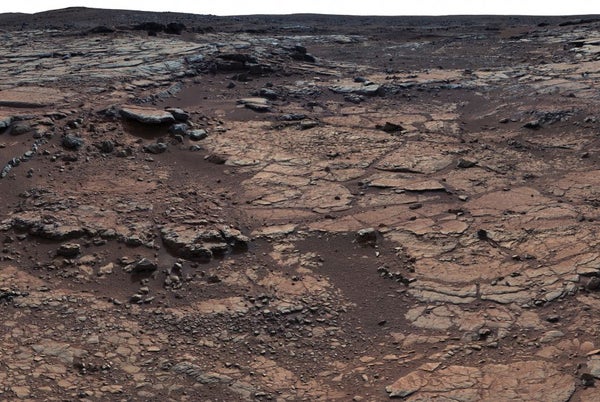
Robot explorers have found Mars to be a world of sulfur, acids, magnesium, iron and chlorine compounds, all of which are sunbaked and wrapped in a carbon-dioxide-rich atmosphere.
But what would this complex and exotic brew smell like?
It turns out that everyone—not just Mars explorers—might be able to find out, because there may be ways to recreate whiffs of the Red Planet here on Earth. [The 7 Biggest Mysteries of Mars]
On supporting science journalism
If you're enjoying this article, consider supporting our award-winning journalism by subscribing. By purchasing a subscription you are helping to ensure the future of impactful stories about the discoveries and ideas shaping our world today.
Headspace tech
One relatively recent innovation in the perfume business is "Headspace" technology.
"It gathers the molecules, and then the sample is brought back to the lab to be analyzed by spectral analysis. The results are typically synthesized to create a scent that mimics the smell of those molecules," said Jacquelyn Ford Morie, founder and chief scientist of the California-based company All These Worlds LLC, which uses virtual reality (VR) and other technology to create "immersive experiences" for a variety of applications.
Morie thinks Headspace, or something like it, could be used to decode the smell of Mars.
"I think that new artisan fragrance designers would love to design a series of scents that are their own, nonsampled interpretations of what Mars might smell like," she told Space.com.
A future mission could take a spectroscopic reading of the Martian atmosphere, then beam that information back to Earth, where Headspace hardware could reconstruct (or evoke) the Red Planet scent, Morie added.
"That's the cool thing about the artisan scent designers," she said. "They can add the more stinky elements to make a scent that hints at the real Mars while still being cool to smell. Many top fragrances have small bits of those otherwise smelly elements in them."
Eau de Red Planet
Morie suspects that the predominant Mars odor is a slightly acrid, gassy smell of sulfur compounds, with a chalky, sweet overtone punching through. This scent would become a big part of Red Planet settlers' lives.
"Imagine 30 or 40 years from now, when we have established colonies on Mars, and the colonists have become not only accepting of the scented detritus they track into their habitats, but actually consider it the smell of home," Morie said.
Future colonists could perhaps also use finely crafted habitat scents as harmonious counterpoints to the native smells of their adopted planet, she added.
Studies have shown repeatedly that smell is intimately tied to memory; whiffs of a familiar scent can trigger nostalgia and other strong feelings about times long past.
So, if Mars colonists "need to return to Earth, they would absolutely require a vial or two of 'Eau de Red Planet' to remind them of their life on this distant human outpost," Morie said.
Extraterrestrial encounters
Decoding or replicating Mars' scent would not be the first extraterrestrial encounter of the odor kind.
During the Apollo lunar landing program, for example, some of the moonwalkers noticed that they had brought back rock and dust particles into their lunar module. The material tainted their spacesuits. Once the astronauts took off their helmets, the moon's smell—which was likened to wet ashes in a fireplace, or spent gunpowder from a just-fired shotgun—was evident.
Then, in 1998, scientists with New York-based International Flavors & Fragrances Inc. (IFF) sent a miniature rose plant aboard the space shuttle Discovery on its STS-95 mission, to study the effect of microgravity on scent.
Using proprietary technologies, the team, led by Braja Mookherjee, tracked radical shifts in the living flower's scent over the course of the shuttle flight.
"Ultimately, they discovered and created new-to-world profiles that have since gone on to enormous commercial success," IFF representatives wrote in a blog post late last year.
In addition, artisan Carrie Paterson has investigated making scents of life on Earth that can be embedded as olfactory information into multichannel interstellar messages. Then, there's the work of designer Saskia Wilson-Brown, who's interested in finding out what UFOs might smell like.
Copyright 2016 SPACE.com, a Purch company. All rights reserved. This material may not be published, broadcast, rewritten or redistributed.